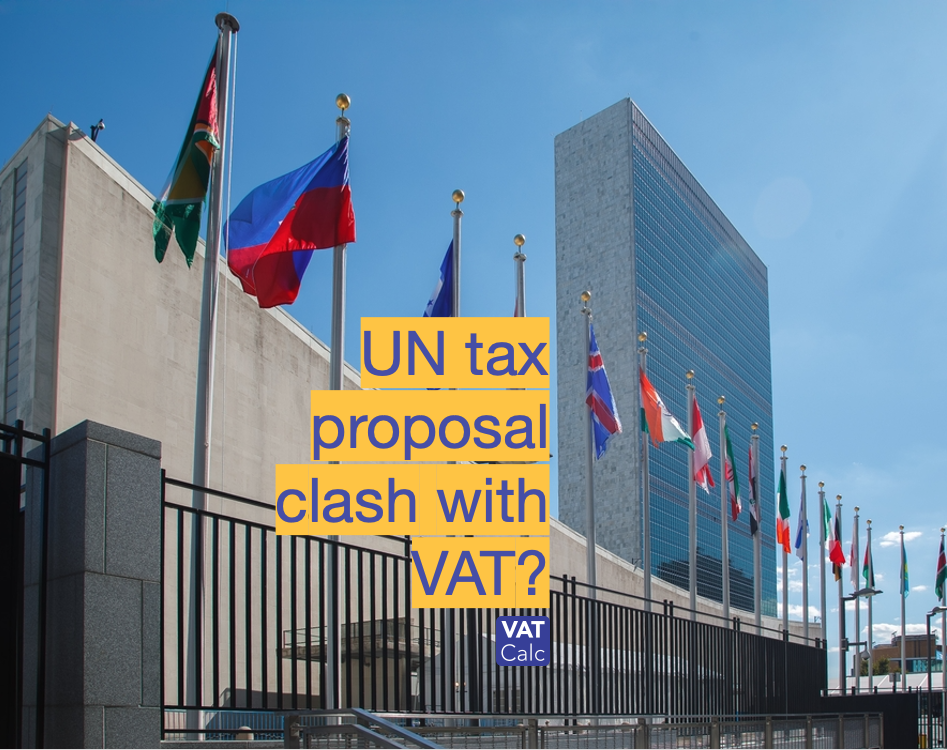
Europe seeks opt-outs from new UN source-country taxing rights as international tax rules follow VAT towards the customer
The United Nations is developing new rules to give countries greater rights to tax income earned by foreign suppliers of cross-border services, potentially extending source-country taxation even where the supplier has little or no traditional physical presence.
But European countries are pushing back.
A group of mostly European states, including France, Ireland, Italy, the Netherlands, Norway, Switzerland and the UK, is seeking greater optionality in the proposed UN Protocol on the Taxation of Income from Cross-Border Services. Some want countries to be able to enter reservations against individual provisions rather than accepting the protocol as a package.
The dispute exposes a wider issue for international taxation: income tax is beginning to confront a cross-border services problem that VAT and GST systems have already spent more than a decade addressing.
UN looks beyond physical presence
The protocol forms part of negotiations on the UN Framework Convention on International Tax Cooperation. Final texts are due to go before the UN General Assembly in 2027.
It is not a digital services tax. Its potential scope is considerably wider, covering income from cross-border services in an increasingly digitalised economy. The UN process has considered areas including fees for services and automated digital services, with mechanisms potentially allowing source countries to impose tax on a gross basis.
The policy problem is straightforward.
Digitalisation means a business can supply substantial volumes of professional, technical or digital services into another country without establishing the physical presence traditionally required for that country to tax its business profits.
The proposed protocol would shift more taxing rights towards the country from which the service income is considered to arise.
UN-backed research published in August estimates that the effect could be to redistribute taxing rights towards jurisdictions that are net importers of affected services, although the outcome depends heavily on participation, treaty interaction and double-tax relief.
Haven’t we seen this before with VAT?
There is a striking parallel with international VAT and GST.
VAT systems have already progressively moved away from asking where a foreign supplier is established and towards asking where the customer and consumption are located.
For B2B services, this commonly means destination taxation through the reverse charge. For B2C digital and other remotely supplied services, many countries instead require the overseas supplier to register and collect local VAT or GST.
The UN proposal is not VAT and does not duplicate VAT legally. It taxes income rather than consumption.
But economically, the two regimes could increasingly converge on the same cross-border transaction.
Consider a business supplying services remotely from Country A to a corporate customer in Country B.
Country B may already impose VAT or GST because that is where the service is consumed. Under expanded UN source rules, Country B could potentially also acquire income-taxing rights over the foreign supplier’s service fee.
The supplier could therefore face destination-country VAT treatment, source-country income or withholding tax and residence-country corporation tax, with treaty or other relief then required to prevent double income taxation.
That potentially adds a significant new layer of tax complexity to international B2B services.
Europe wants an escape route
This helps explain the resistance emerging from European countries.
At the UN’s August negotiations, European representatives raised concerns over legal certainty, double taxation and the interaction of the protocol with existing bilateral treaties. Malta, supporting positions expressed by other EU Member States, argued that participation should remain optional and that the protocol should not automatically modify existing treaty obligations.
Ireland, the Netherlands, Latvia and the Czech Republic have raised particularly significant concerns, while a broader group is seeking the ability to reserve against parts of the eventual agreement.
That optionality is itself controversial.
Developing economies generally stand to gain more from expanded source-country taxation because they are often net importers of services. The South Centre has argued against allowing reservations on key substantive provisions, warning in effect that extensive opt-outs could undermine the new source taxing rights the protocol is intended to create.
This creates the central tension in the negotiations: the countries most concerned about accepting the new taxing rights are often the countries exporting the services that other jurisdictions want to tax.
Income tax follows VAT towards the customer
VAT provides an interesting precedent for where the debate may ultimately be heading.
International VAT reform has increasingly accepted that physical establishment is an inadequate basis for taxing a digitalised economy. Consumption taxes have therefore moved towards destination principles, customer-location evidence, non-resident obligations and increasingly sophisticated digital reporting.
Income taxation has historically been much more dependent on residence, permanent establishment and physical presence.
The UN negotiations suggest that distinction is coming under increasing pressure.
There is no direct collision between VAT and the proposed UN rules. But multinational businesses could find the same cross-border service increasingly subject to two destination or source-country tax claims built on different tax principles and administered through entirely separate compliance regimes.
Europe’s attempt to secure opt-outs demonstrates how much more contentious that transition becomes when the tax being redistributed is not VAT on consumption, but taxing rights over the foreign supplier’s income.