What happens when the VAT number can’t be verified?
July 2028 EU’s Single VAT Registration reforms will make VAT numbers more important than ever. But what happens when they cannot be validated?
One of the least discussed elements of the EU’s VAT in the Digital Age (ViDA) reforms is the creation of new digital taxpayer identity.

The European Commission is creating a common identification framework that will underpin the expanded One Stop Shop (OSS), Single VAT Registration (SVR), digital reporting and cross-border e-invoicing. VAT identification numbers become the common language linking businesses, invoices and tax authorities across Europe.
That makes perfect sense. But it also creates a new question.
What happens when a VAT number cannot be verified?
Digital compliance depends on digital infrastructure
Today, a VAT number is one element of VAT compliance.
Tomorrow, it becomes part of the infrastructure supporting real-time digital reporting.
Businesses will increasingly validate VAT numbers:
- before issuing invoices;
- before accepting purchase invoices;
- during supplier onboarding;
- when exchanging e-invoices;
- before applying the reverse charge.
That inevitably increases reliance on the EU’s VAT Information Exchange System (VIES) which is being upgraded in 2030 and the underlying Member State databases.
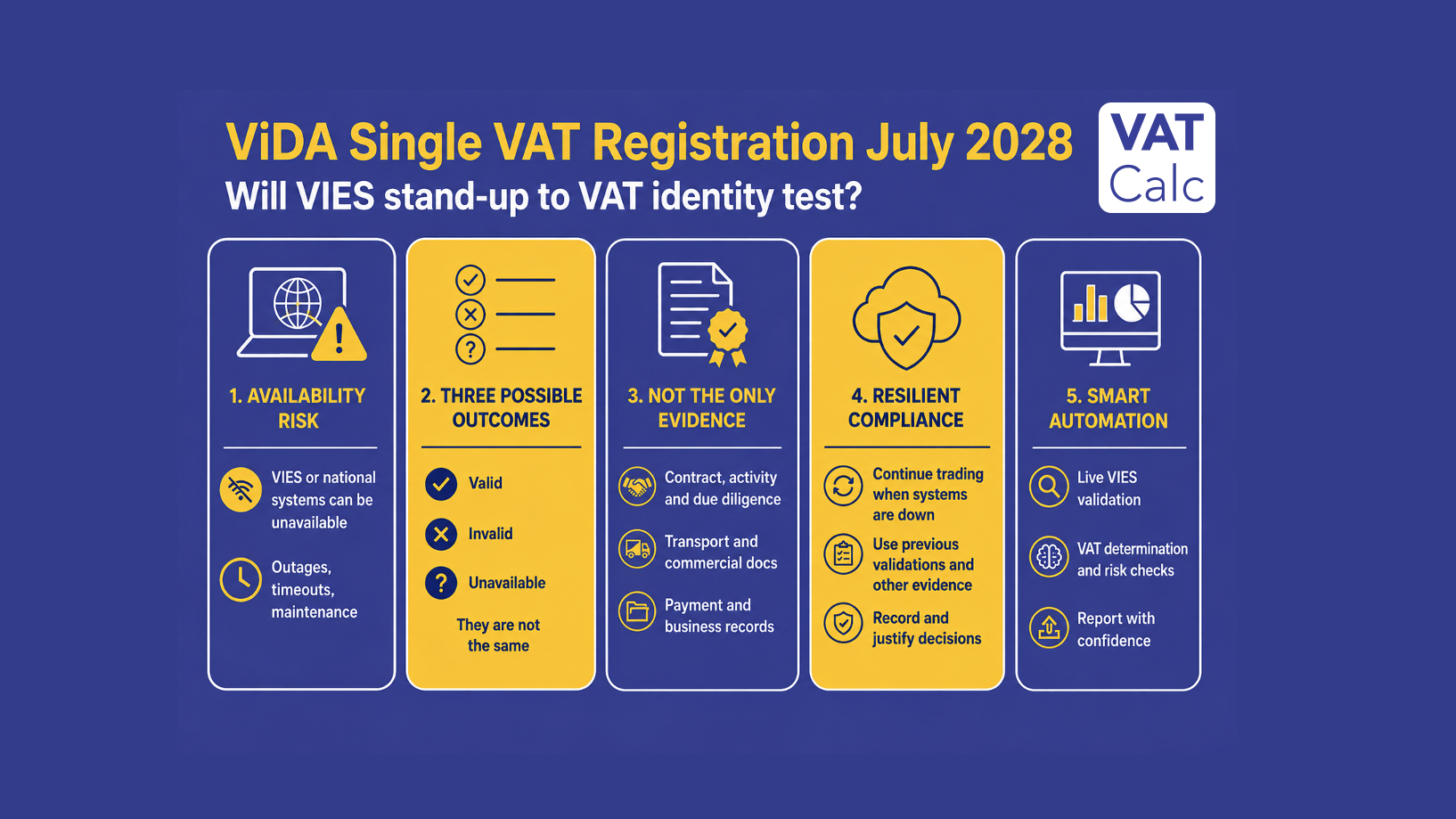
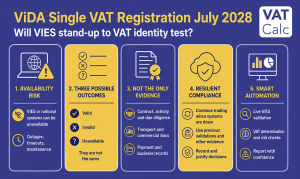
The bad news: there are three outcomes – not two
Most VAT systems today treat a validation as either:
- Valid; or
- Invalid.
In reality there is a third possibility: Unavailable.
- A Member State’s database may be offline.
- The VIES gateway may be temporarily unavailable.
- A network timeout may occur.
None of those mean the customer’s VAT registration is invalid.
Treating a temporary systems issue as evidence that a business is not VAT registered risks delaying invoices, interrupting trading relationships and generating unnecessary compliance exceptions.
These are operational issues that become much more significant as Europe moves towards mandatory digital reporting.
A VAT number has never been the only evidence
Businesses should also remember that a VAT number has never been the sole evidence that a customer is acting as a taxable person. There’s also:
- Commercial contracts.
- Customer due diligence.
- Business activities.
- Transport documentation.
- Payment records.
These all continue to form part of the wider evidential picture.
Digitalisation should not accidentally reduce a complex compliance judgement to a single API response.
Resilience matters
The ViDA legislation does not require businesses to obtain a successful live VAT validation before issuing an invoice.
That is sensible.
If invoice issuance depended entirely upon a real-time validation response, every outage or connectivity problem could disrupt legitimate trade.
Instead, the challenge is designing systems that distinguish between:
- a genuinely invalid VAT registration; and
- a temporary inability to verify it.
Those are fundamentally different outcomes.
The technology challenge
This is where tax technology becomes increasingly important. VAT validation should not simply return “Yes” or “No”.
It should provide resilient decision-making.
For example:
- perform live validation where available;
- retain evidence of successful previous validations;
- distinguish invalid registrations from unavailable services;
- allow retry workflows where appropriate;
- record the validation outcome for audit purposes.
That creates a much more robust compliance process than relying on a single point-in-time validation.
How tech can nail this problem in real time
At VATCalc, live VIES validation is already embedded across VAT determination, purchase invoice review, sales invoicing and e-invoicing workflows.
But validation is only one part of the decision.
The platform also determines the correct VAT treatment using legislative rules and transaction context, rather than relying solely on whether a VAT number happens to respond at that particular moment.
As ViDA moves Europe towards real-time digital compliance, that distinction becomes increasingly important.
The challenge is no longer simply “Is this VAT number valid?”
It becomes:
“Can the business continue trading compliantly when the digital infrastructure isn’t perfect?”
EU VAT in the Digital Age reforms
| EU VAT in the Digital Age | |
| 3 pillars to improve efficiency of VAT for all and reduce fraud | |
| 1. Digital Reporting Requirements; e-invoicing | Jul 2030-35: Mandatory digital reporting of intra-community transactions; obligation to be able to issue and receive intra-community e-invoices; member states free to impose own e-invoicing or real-time reporting but most conform to EU e-invoice standard EN 16931 |
| Read more about EU Digital Reporting Requirements (DRR) | |
| Structured e-invoices mandated for intra-community supplies | |
| EC Sales lists replaced by Digital Reporting Requirements | |
| 10-day e-invoicing deadline for intra-community sales | |
| 5-day e-reporting time limit intra-community purchases | |
| Withdrawal of EU permission requirements for e-invoicing | |
| Central VIES database launch | |
| 2 Platform economy | Jul 2028 / Jan 2030: Travel & accommodation sharing platforms to become deemed supplier / liable to users' VAT. New definitions of the roles of providers, users and platforms to avoid double and no-taxation (voluntary Jul 2028) |
| Read more - Travel & accommodation platforms deemed suppliers for EU VAT | |
| 3 Single VAT Registration; extension of OSS | July 2028: Following the 1 July 2021 introduction of the One Stop-Shop (OSS), extended to cover movement of own stocks prior to cross-border B2C to reduce the foreign, non-resident VAT registrations & returns. Plus to movements of own stock with ending of 'call-off' stock burden |
| January 2027 initial changes | |
| Transfer of own goods OSS extension | |
| Call-off stock VAT simplification ends | |
| Harmonisation of B2B Reverse Charge rules | |
| Creation of Single VAT Registration identiy | |
| Securing IOSS (Mar 2028) | |