
E-invoicing solves an important compliance problem. It gets invoice data into the required format and, increasingly, transmits it to customers and tax authorities in near real time. We’re hearing from our customers that this is becoming their main worry over the next few years – examples like Hungarian NAV and Romania
They know accepting an e-invoice does not mean the VAT is right.
As e-invoicing and digital reporting spread, including EU ViDA from 2030, businesses are creating several versions of their VAT data at different stages of the compliance process. Keeping them aligned is becoming the next challenge.
E-invoicing adds another VAT control point
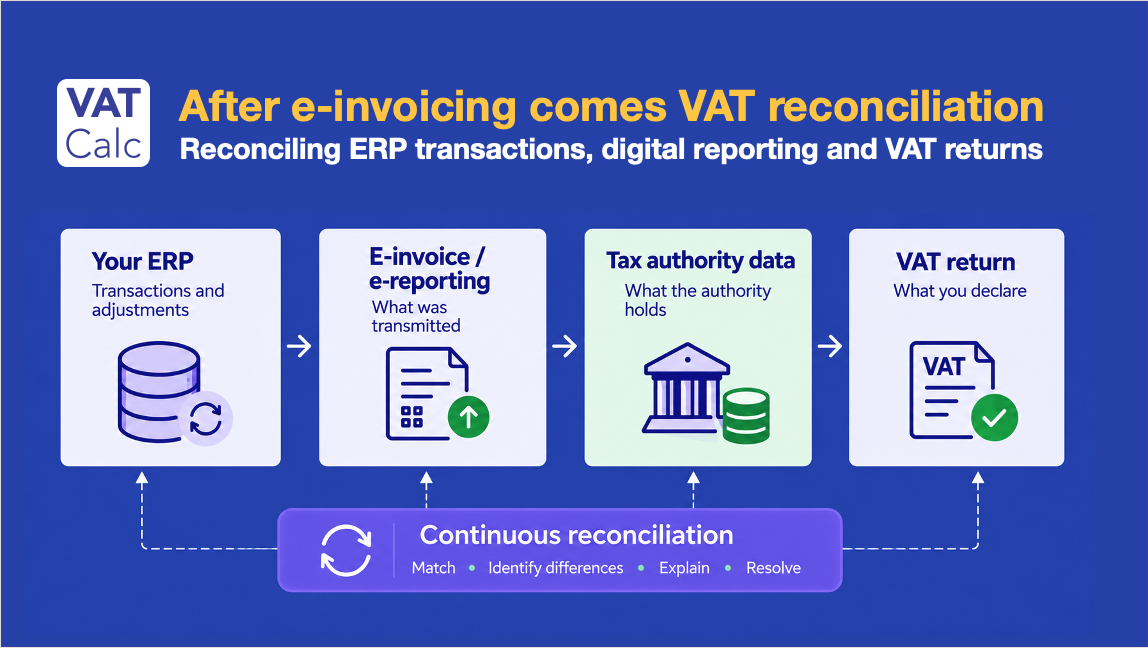
Traditionally, businesses extracted transactions from their ERP, performed VAT checks and adjustments, and periodically filed a VAT return.
Increasingly, invoice and transaction data are being transmitted to tax authorities much earlier.
The VAT data chain is becoming:
ERP transaction → VAT determination → e-invoice/e-reporting → VAT return
There are plenty of opportunities for differences. The original VAT treatment may be wrong. An invoice could be rejected or subsequently corrected. An ERP adjustment may not reach the reporting system, while transactions reported during the period may not ultimately appear in the VAT return in the same way.
Successful transmission proves that an invoice passed one control. It does not prove that the end-to-end VAT position is correct.
Tax authorities are starting to reconcile too
Recent developments show where this is heading.
As we explored in our recent Hungary eVAT update, NAV is increasingly able to validate VAT data against transaction information it already holds. Romania’s e-VAT experience demonstrates the challenge from the opposite direction: even extensive e-invoice, SAF-T and transactional data do not necessarily enable a tax authority to reconstruct the correct VAT return.
An IOTA proposal for automated VAT reconciliation takes this further, considering how tax administrations could automatically compare transaction data with VAT returns and identify discrepancies.
That changes the risk for taxpayers. If the tax authority can reconcile what you reported during the period against your VAT return, you need to find the differences first.
The best evidence we’ve seen of this is HMRC’s response to the UK e-invoicing consultation explicitly recognises that e-invoicing data alone would not be sufficient to produce a pre-populated VAT return. Respondents also raised concerns about reconciling pre-populated data with internal records, particularly for complex taxpayers.
The missing reconciliation layer
Businesses therefore need to connect what happened in the ERP, how VAT was determined, what was transmitted through e-invoicing or e-reporting, and what was eventually declared on the VAT return.
Crucially, that reconciliation needs to work backwards too. A discrepancy in a return should be traceable through the reporting records to the underlying transactions and VAT treatment.
Pre-filled VAT returns add another version of the truth: what the tax authority thinks happened.
As we examined in our earlier pre-filled VAT returns and e-Reconciliation analysis, greater use of tax authority data does not make VAT compliance disappear. It changes the job. Businesses increasingly need to validate the authority’s data against their own records and explain why the two positions differ.
After e-invoicing comes reconciliation
E-invoicing therefore cannot sit in isolation from VAT determination and VAT reporting. The emerging compliance process is better represented as:
Determine → Invoice → Report → Reconcile → File
Over time, reconciliation is also likely to become less of a periodic check performed while preparing the VAT return and more of a continuous control running alongside digital reporting.
E-invoicing tells the tax authority what you reported. Reconciliation helps prove that what you reported was right.