Structured invoices, transaction reporting and AI analysis could give German tax authorities a new view of VAT risk
Germany’s latest e-invoicing guidance may point to something much bigger than the January 2027 mandate.

The immediate challenge for businesses is producing structured invoices that pass technical validation. But Germany is also assembling the ability to audit the VAT treatment of transactions automatically and at scale.
E-invoices are becoming tax datasets
The German Federal Ministry of Finance (BMF) requires mandatory VAT invoice information to sit within the structured, machine-readable invoice data.
Importantly, the description of the supply must be sufficient to identify the underlying transaction and support assessment of its VAT treatment. The invoice is therefore more than a PDF converted into XML. It is becoming a structured tax dataset.
That matters because structured data can be analysed.
Then comes VAT reporting — and AI
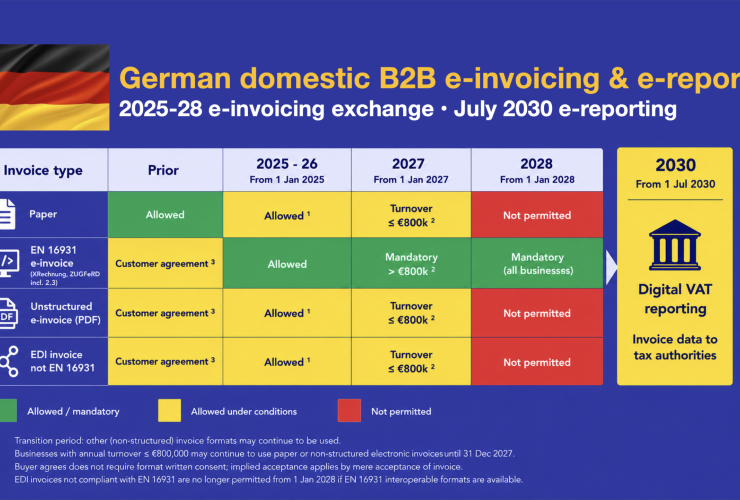
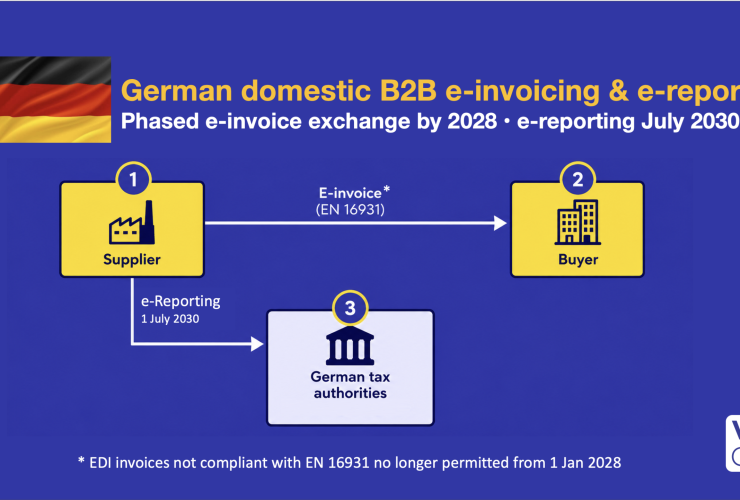
Germany has already made clear that e-invoicing is intended to prepare for its future transaction-level VAT reporting system. The latest BMF guidance even acknowledges that e-invoicing rules may need adapting once that system is finalised.
Then, in July 2026, the government outlined its action plan against tax and financial crime proposed a central tax-data platform, a data analysis centre and AI-supported tools to identify patterns in financial data.
Connect the pieces:
Structured e-invoice → transaction reporting → central tax data → automated risk analysis
Germany has not said AI will determine the correct VAT treatment of every invoice. But it could increasingly have the data and analytical capability to identify transactions that look wrong.
A valid XML invoice can still have the wrong VAT
Today, businesses are understandably focused on whether an invoice has the correct format, mandatory fields and technical structure. But passing XML validation does not mean the VAT treatment is correct.
A service could be perfectly described and the invoice perfectly formatted — while the wrong place-of-supply rule, VAT rate or exemption has been applied. With richer transaction data, tax authorities could potentially identify those inconsistencies systematically rather than discovering them through traditional sample audits.
That pushes the compliance challenge upstream into ERP tax logic, tax codes, customer and product master data, and ultimately the quality of the original VAT determination.
From auditing samples to analysing transactions
Germany has not announced an automated VAT audit system. But structured e-invoices provides the data.
Transaction reporting gives tax authorities access to it. Centralised platforms bring the datasets together. AI and analytics provide increasingly powerful ways to interrogate them.
The biggest transformation from e-invoicing may therefore not be the move from PDF to XML.
It may be the move from auditing samples of transactions to analysing VAT risk at scale.