
BMF issues new e-invoicing letter 15 October 2026
17 October 2026 – Germany’s Federal Ministry of Finance (BMF) has issued further guidance via DATEV on mandatory B2B e-invoicing ahead of the 1 January 2027 issuing deadline.
The 15 October 2026 letter supplements BMF guidance from 2024 and 2025 and updates Germany’s VAT Application Decree (UStAE). It does not change the mandate timetable. It follows on from
The guidance inlines that Germany’s mandate technologically less prescriptive than many of Europe’s newer e-invoicing regimes such as France or Poland. The trade-off is that businesses retain more responsibility for determining whether an invoice is actually VAT-compliant. It’s worth check the latest German FAQ’s, too
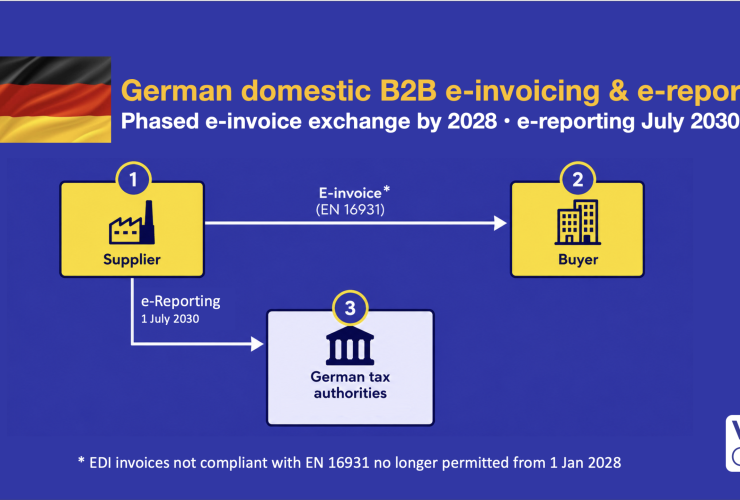
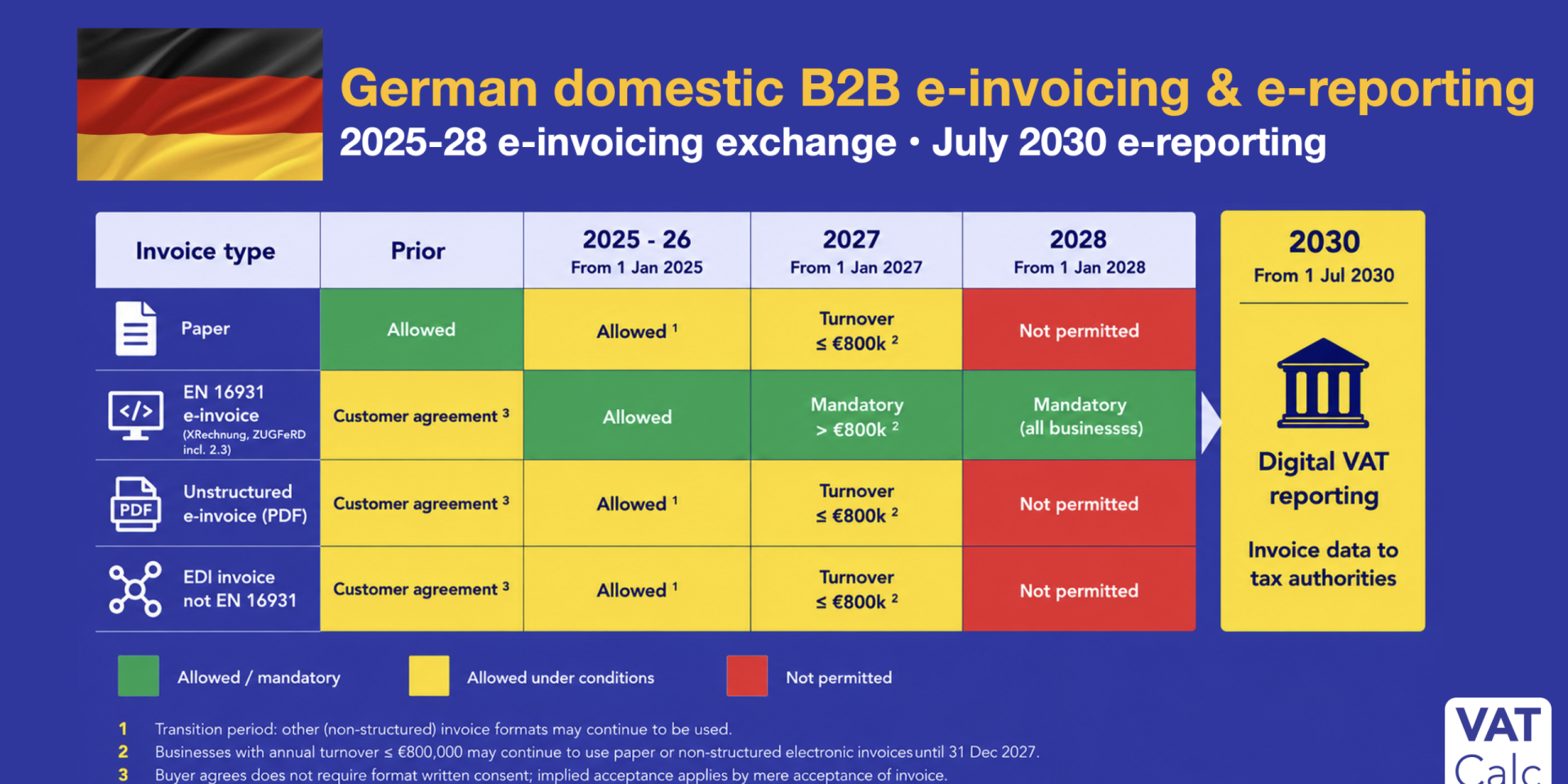
Businesses with prior-year turnover above €800,000 must generally issue structured domestic B2B e-invoices from January 2027. The remaining transitional relief expires at the end of 2027. Germany is also planning 2030 domestic e-reporting to synchronise with EU ViDA’s own intra-community supplies Digital Reporting Requirements pillar.
Mandatory VAT information must be structured
All mandatory VAT invoice information must be contained within the structured e-invoice data.
The data must identify the nature and extent of the supply sufficiently to determine its VAT treatment. Supporting commercial information not required for this assessment, such as detailed timesheets, may instead be included in an attachment embedded within the e-invoice.
An inadequate description of the supply may put the customer’s input VAT deduction at risk.
Construction invoices and supporting documents
The BMF provides flexibility for construction invoices where detailed bills of quantities cannot be fully represented in standard structured invoice formats.
Individual trades and their totals may be included in the structured invoice, with the detailed bill of quantities in an embedded, clearly referenced attachment. The breakdown may also be provided as a separate structured file, such as Germany’s GAEB construction format.
Advance payments and final invoices
Advance, prepayment and instalment invoices issued before a supplier becomes subject to mandatory e-invoicing do not subsequently have to be converted into e-invoices, even if payment or supply occurs later.
For final invoices, transitional relief has been extended to 30 June 2030.
Payments already received may be aggregated in the structured BT-113 Paid amount field, with the underlying net and VAT details provided through BT-22 Invoice note. Alternatively, the details may be included in an embedded attachment referenced by the structured invoice.
Invoice corrections must also be electronic
A correction to an e-invoice must itself be an e-invoice.
However, the BMF does not prescribe a single correction method. Replacement invoices, cumulative corrections and agreed credit-note arrangements may be used, provided the original invoice and corrections together establish the final position clearly.
Technical errors do not always invalidate an e-invoice
One of the most important clarifications is the distinction between technical validation and VAT validity.
A breach of a technical business rule does not automatically mean a document ceases to qualify as an e-invoice for VAT purposes. Fundamental format errors may invalidate its status, while business-rule errors may not.
Where an error affects legally required VAT information, however, the invoice may still require correction.
For automated invoice processing, this is an important distinction: passing or failing technical validation does not by itself establish whether the VAT treatment is correct.
Gross-price invoices and discounts
The BMF also provides temporary relief for VAT-inclusive pricing where structured calculations can create rounding differences.
Until 31 December 2027, qualifying invoices may show aggregated net totals by VAT rate in the structured data, with individual items detailed in an embedded attachment.
For discounts agreed in advance, the invoice must identify the arrangement unless the discount is already reflected in the price. If the amount is not yet known, a clear reference to the underlying agreement may be sufficient.
Mixed business and consumer customers
Suppliers serving both businesses and consumers receive protection where they could not reasonably know that a customer was purchasing in a business capacity.
For continuing mass-market contracts, such as energy supplies, checking customer status when the contract starts or changes may be sufficient. Continuous verification is not required.
Transition protection until the end of 2026
Invoices issued up to 31 December 2026 in accordance with the BMF’s 2024 and 2025 guidance will not be challenged solely because they fail to meet additional requirements introduced by the new letter. This protection extends to the recipient’s input VAT deduction.
The BMF also confirms that issuing another invoice format where an e-invoice was required does not itself constitute an administrative offence. The underlying e-invoicing requirement still applies.
What does the new guidance mean for businesses?
The new letter provides useful flexibility for complex invoices, attachments and corrections, while drawing a clearer line between technical e-invoice validation and VAT compliance.
Businesses preparing for January 2027 should therefore ensure their systems can populate the required structured VAT data, embed supporting documentation and distinguish technical exceptions from errors that affect the underlying VAT treatment.
Germany takes Europe’s lighter-touch route
Germany’s approach remains notably lighter than the latest French and Polish e-invoicing mandates. There is no central clearance platform equivalent to Poland’s KSeF and no French-style network of approved platforms combined with transaction e-reporting.
Instead, Germany is concentrating on the invoice itself: businesses have considerable freedom over transmission and processing provided the structured invoice meets the VAT requirements.
The latest BMF guidance continues that pragmatic approach. It provides flexibility over attachments, complex invoices and corrections, while recognising that a technical validation error does not necessarily make an invoice invalid for VAT purposes.