Spain has started transposing the ViDA, beginning with technical OSS and e-commerce changes from January 2027
The major Single VAT Registration, platform economy and digital reporting reforms still to come

Spain is progressing the first stage of its implementation of the EU’s VAT in the Digital Age (ViDA) reforms.
The Council of Ministers approved the bill amending Spain’s VAT Law, Ley 37/1992, in June 2026. It has since entered the Spanish Parliament for consideration.
The government describes the legislation as a partial transposition of Directive (EU) 2025/516. It is deliberately limited to the relatively minor ViDA changes applying from 1 January 2027. It does not implement the three ViDA pillars in full.
What changes from January 2027 on Single VAT Registration?
The first Spanish measures concentrate mainly on improving the VAT One Stop Shop (OSS) arrangements introduced as part of the EU e-commerce package in 2021.
One change expands the non-Union OSS scheme, allowing it to cover qualifying services supplied to consumers even where those consumers are not established or resident within the EU.
Spain is also introducing rules requiring certain businesses established outside the EU to appoint a VAT representative where they seek refunds of Spanish VAT connected with transactions reported through the OSS regimes.
Further technical amendments are intended to clarify and improve the operation of the Union, non-Union and Import One Stop Shop schemes.
The measures are intended to apply from 1 January 2027.
Call-off stock prepares for ViDA’s 2028 reforms
Spain’s legislation also contains transitional provisions for the eventual withdrawal of the existing call-off stock simplification. This is necessary because ViDA introduces a new Transfer of Own Goods (TOOG) OSS scheme from 1 July 2028.
The new regime will enable qualifying businesses moving their own inventory between EU Member States to report those movements through OSS rather than maintaining some of the additional foreign VAT registrations required today.
The existing call-off stock arrangements will consequently be phased out as the new system takes over.
Energy supplies move into OSS
Spain is also preparing for the extension of OSS to certain supplies of gas, electricity, heating and cooling.
Transitional provisions allow qualifying energy supplies to use the Union OSS ahead of their formal inclusion within the expanded regime from July 2028.
The major ViDA changes start from 2028
From 1 July 2028, the Single VAT Registration pillar will substantially expand OSS, including the new scheme for transfers of own goods. Mandatory reverse charge rules will also reduce the circumstances in which non-established businesses need local VAT registrations.
The Platform Economy pillar introduces deemed-supplier VAT obligations for qualifying short-term accommodation and passenger transport supplied through digital platforms.
These reforms will require further Spanish implementation measures.
Spain’s domestic e-invoicing is separate
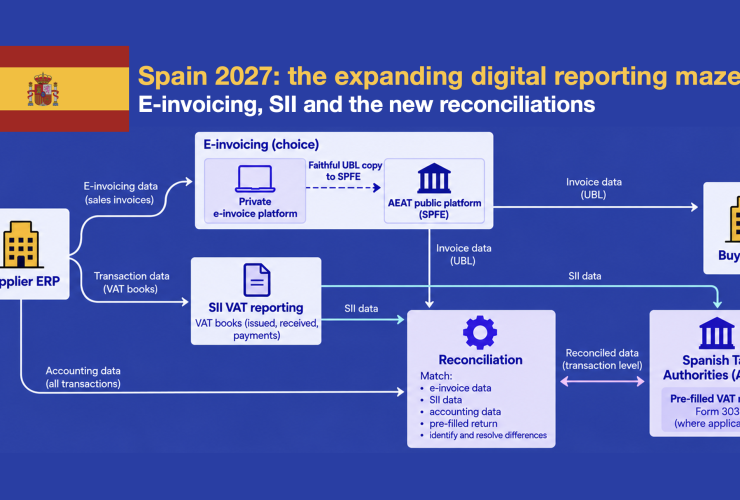
Spain is separately developing mandatory B2B e-invoicing under the Crea y Crece regime, alongside its existing SII and VeriFactu reporting infrastructure.
These domestic requirements should not be confused with ViDA’s EU-wide Digital Reporting Requirements (DRR).
From 1 July 2030, ViDA will introduce structured e-invoicing and transaction-level digital reporting for intra-EU B2B transactions, replacing the existing recapitulative statement system.
Spain will therefore need to integrate its extensive domestic digital VAT infrastructure with the harmonised EU framework.
See more in our Spain VAT Country guide.
EU member states ViDA implementation tracker
| Country (click for details) | Status | Latest | |
| 1 | Austria | ⚪ Awaiting legislation | - |
| 2 | Belgium | 🟠 Bill presented | OSS, distance sales, electronic interfaces and related changes |
| 3 | Bulgaria | ⚪ Awaiting legislation | - |
| 4 | Croatia | 🟡 Draft / consultation | Draft partial transposition for January 2027 |
| 5 | Cyprus | ⚪ Awaiting legislation | - |
| 6 | Czech Republic | 🟠 Parliamentary legislation | OSS changes from January 2027 |
| 7 | Denmark | ⚪ Legislative timetable set | - |
| 8 | Estonia | 🟠 Bill before Parliament | Bill 992 SE: OSS and related changes from January 2027 |
| 9 | Finland | ⚪ Awaiting legislation | National implementation needs confirmation |
| 10 | France | ⚪ Awaiting legislation | ViDA measures notified, but first-stage position needs separating from domestic e-invoicing reforms |
| 11 | Germany | ⚪ Awaiting / monitor | - |
| 12 | Greece | ⚪ Awaiting legislation | - |
| 13 | Hungary | ⚪ Awaiting legislation | - |
| 14 | Ireland | ⚪ Awaiting legislation | - |
| 15 | Italy | 🟡 Draft legislation | Draft legislative decree – parliamentary scrutiny completed |
| 16 | Latvia | ⚪ Awaiting legislation | - |
| 17 | Lithuania | 🟢 Adopted | Law XV-1036 implements initial ViDA changes from January 2027 |
| 18 | Luxembourg | 🟠 Bill before Parliament | Bill 8812 transposes Article 2 from January 2027 |
| 19 | Malta | 🟢 Adopted | Act III of 2026 implements Article 2 from January 2027 |
| 20 | Netherlands | 🟢 Adopted | Implementation Act published October 2026; January 2027 commencement |
| 21 | Poland | 🟠 Parliamentary legislation | Bill 3074 passed Sejm; January 2027 provisions |
| 22 | Portugal | ⚪ Awaiting legislation | - |
| 23 | Romania | ⚪ Awaiting legislation | - |
| 24 | Slovakia | 🟡 Draft legislation | ViDA transposition combined with January 2027 domestic e-invoicing reforms |
| 25 | Slovenia | ⚪ Awaiting legislation | - |
| 26 | Spain | 🟠 Government legislation | Partial ViDA transposition underway in Parliament |
| 27 | Sweden | ⚪ Awaiting legislation | - |