Tax Service signals pre-clearance B2B e-invoicing, with technical model and implementation details still pending
The Central American state of Belize has given the legislative go-ahead to mandatory e-invoicing and e-receipts in the 2026/7 Budget presented in March 2026.
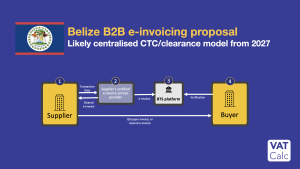
On 9 June 2026 it issued Frequently Asked Questions which gives indirect information on the model which will follow a Latin American CTC or clearance model rather than a European model. Technical specifications are expected during the 2026-27 implementation programme.

Belize e-Invoicing FAQs – Latin America pre-clearance model likely
The FAQs provide the first practical indication of how the future regime will operate, although detailed technical regulations are still to follow.
What is e-invoicing?
Electronic invoices are digital tax invoices generated, transmitted and stored electronically through approved systems. They are intended to replace traditional paper invoices and improve tax compliance and transparency.
Who will be affected?
The regime is expected to apply to GST-registered businesses. The government has confirmed that all GST-registered businesses will ultimately be required to issue and report invoices electronically.
Is e-invoicing mandatory now?
No. Belize is still in the implementation phase. The legal framework has been introduced, but the BTS is developing the detailed operational requirements, technical standards and rollout timetable. Mandatory implementation is expected by 2027.
Will businesses need approved software?
Yes. Businesses will need software capable of generating compliant electronic invoices and communicating with the BTS system. Further specifications and accreditation requirements are expected to be published by the tax authority.
What are the objectives of the new system?
The BTS FAQ’s identifies several benefits:
- Reduction of tax evasion and fraud
- Improved tax intelligence and audit capabilities
- Faster and more accurate compliance processes
- Reduced paperwork and administrative burdens
- Better record keeping and invoice traceability
Will paper invoices disappear?
The long-term objective is to move businesses towards electronic invoicing and electronic receipts. However, transitional arrangements are expected as the system is rolled out. Detailed rules are still awaited.
Belize GST
Belize’s General Sales Tax (GST) is a value-added tax applied to the supply of goods and services within the country. The standard GST rate is 12.5%, levied at each stage of production and distribution. Businesses with annual taxable supplies exceeding BZD 75,000 must register for GST.
Certain essential goods and services, such as medical supplies, financial services, and education, are either zero-rated or exempt. Zero-rated supplies, including exports and basic food items, are taxed at 0%, allowing businesses to claim input tax credits. Exempt supplies, such as residential rent and public transport, do not allow input tax credit claims.
GST returns must be filed monthly, with payments due by the 15th of the following month. Penalties apply for late filings and payments. The Belize Tax Service Department administers GST, ensuring compliance through audits and enforcement measures.
Central and South America e-invoicing
| Country | Date | Comments (click for details) |
| Argentina | 2003 | e-Factura Electronic Authorization Code system |
| Belize | 2027? | E-invoicing and e-receipts |
| Bolivia | Dec 2021 | SFE Pre-clearance model |
| Brazil | 2005 | Nota Fiscal Electronic NF-e |
| Chile | 2001 | DTE tax invoice |
| Colombia | Nov 2020 | e-invoice CUFE |
| Costa Rica | 2018 | Pre-clearance |
| Dominican Republic | 2024 | Mandatory e-invoicing phased introduction |
| Ecuador | 2014 | SFEP VAT e-invoicing |
| El Salvador | 2022 | Pre-clearance e-invoicing law passed |
| Guatemala | 2019 | e-invoice FEL |
| Mexico | 2011 | Pre-clearance e-invoice CFDI |
| Panama | 2021 | SFEP VAT e-invoicing with third-party agent required |
| Paraguay | 2022 | Marangatú, a pre-clearance e-invoice system started 1 Jan 2022 |
| Peru | 2010 | Pre-clearance invoice; requirement for approved e-invoice agent |
| Uruguay | 2019 | CFE pre-clearnance e-invoicing |
| Venezuela | 2019 | E-invoicing for select groups |