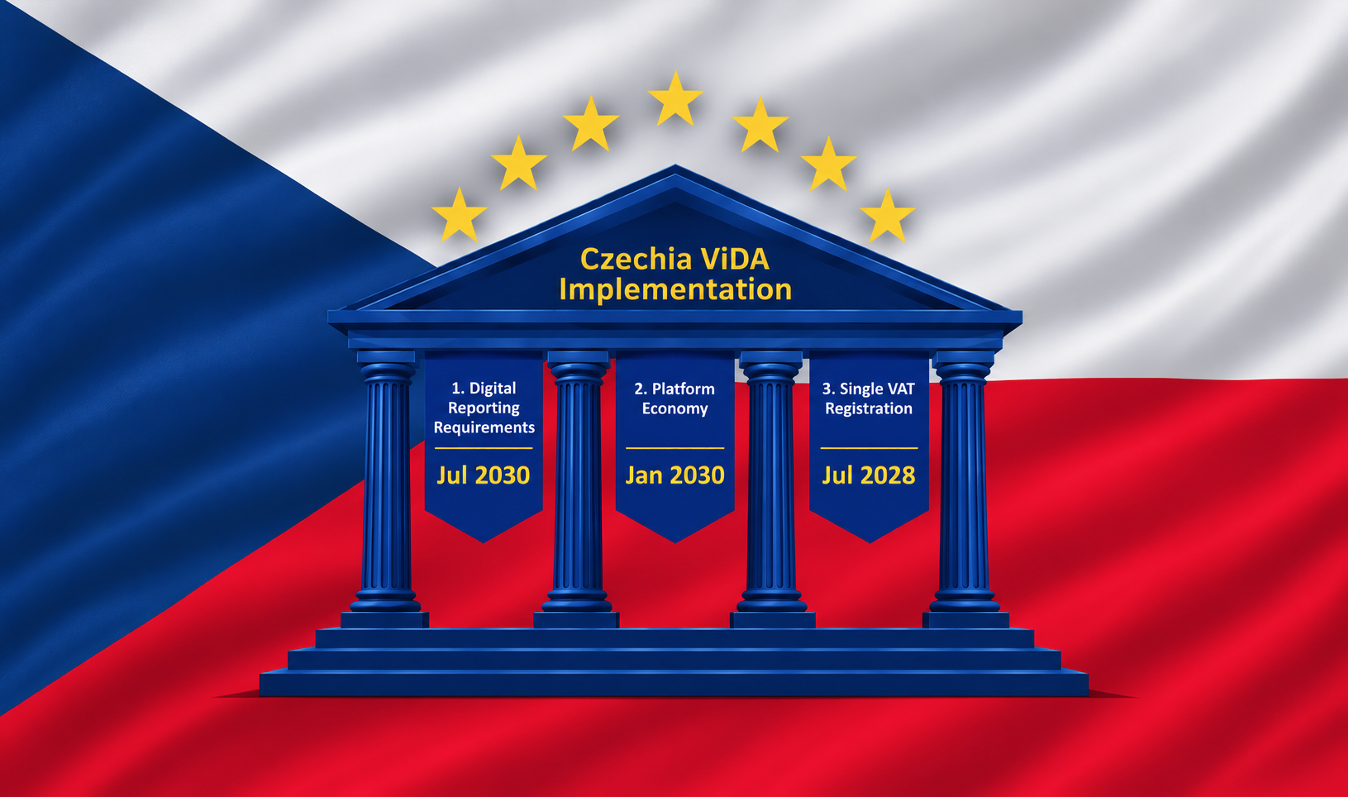
The Czech Republic is transposing the EU VAT in the Digital Age reforms, beginning with OSS, platform and e-commerce changes from January 2027
The major Single VAT Registration, platform economy and digital reporting reforms will follow in separate legislation

The government submitted Bill 218, amending the Czech VAT Act, to Parliament in June 2026. The legislation transposes Article 2 of Directive (EU) 2025/516, covering the first VAT in the Digital Age measures applying from 1 January 2027.
The Czech government has limited the scope in its first draft: this is only the first stage. Separate legislation will be required for the much larger ViDA changes taking effect from 2028 and 2030.
What changes from January 2027?
The initial Czech ViDA reforms focus principally on the existing One Stop Shop (OSS) arrangements and cross-border e-commerce.
The legislation clarifies place-of-supply rules for businesses using OSS and aligns the timing of VAT becoming due for transactions reported through the scheme.
The aim is to make it clearer which Member State taxes a cross-border transaction and reduce uncertainty for businesses using OSS rather than maintaining multiple local VAT registrations.
The changes also refine the €10,000 threshold applying to certain intra-EU distance sales and services.
Platforms face wider deemed-supplier rules
The bill also expands the circumstances in which an electronic interface or online marketplace is treated as the supplier for VAT purposes.
This extends the existing deemed-supplier principle where platforms facilitate certain supplies of goods by foreign sellers to consumers and other non-taxable customers.
The change is part of the initial ViDA e-commerce reforms rather than the much wider Platform Economy pillar applying to short-term accommodation and passenger transport from 2028.
Energy supplies move into OSS
Cross-border supplies of gas, electricity, heating and cooling will also be brought within the OSS framework.
This should allow qualifying suppliers to account for VAT through a single registration rather than registering separately in Member States where these supplies are taxed.
Call-off stock prepares to disappear
The Czech legislation also starts the withdrawal of the existing call-off stock simplification.
New movements will no longer be able to enter the regime from 1 July 2028, with transitional arrangements continuing for existing stock movements until 30 June 2029.
This prepares for ViDA’s new Transfer of Own Goods (TOOG) OSS scheme, which forms part of the major Single VAT Registration reforms from July 2028.
TOOG will allow qualifying businesses moving their own inventory between EU Member States to report those movements through OSS, reducing the need for some additional foreign VAT registrations.
The July 2028 Single VAT Registration reforms come next
The current Czech bill does not implement the complete Single VAT Registration (SVR) pillar.
From 1 July 2028, ViDA significantly expands OSS, introduces TOOG OSS and extends mandatory domestic reverse charge treatment for certain supplies by non-established businesses.
The Czech government has confirmed that these larger reforms will be dealt with in subsequent legislation.
Platform economy reforms voluntary 2028, mandatory 2030
The same applies to ViDA’s Platform Economy pillar.
From 1 July 2028, ViDA introduces new deemed-supplier VAT initially optional obligations for digital platforms facilitating short-term accommodation and passenger transport, subject to the transition options available to Member States.
These should not be confused with the electronic marketplace changes contained in the current Czech bill.
The present measures adjust existing e-commerce platform rules. The wider ViDA platform reforms are still to come.
Digital reporting and e-invoicing waits until July 2030
The current legislation also does not introduce ViDA’s Digital Reporting Requirements (DRR).
From 1 July 2030, intra-EU B2B transactions will move to transaction-level digital reporting based on structured electronic invoices, replacing today’s recapitulative Intrastat statements.
Unlike several other Member States, the Czech Republic has not used this first ViDA implementation bill to introduce a general domestic B2B e-invoicing mandate.
See more in our Czech VAT Country guide.
EU member states ViDA implementation tracker
| Country (click for details) | Status | Latest | |
| 1 | Austria | ⚪ Awaiting legislation | - |
| 2 | Belgium | 🟠 Bill presented | OSS, distance sales, electronic interfaces and related changes |
| 3 | Bulgaria | ⚪ Awaiting legislation | - |
| 4 | Croatia | 🟠 Draft / consultation | Draft partial transposition for January 2027 |
| 5 | Cyprus | ⚪ Awaiting legislation | - |
| 6 | Czechia | 🟠 Bill in Parliament | OSS changes from January 2027 |
| 7 | Denmark | ⚪ Legislative timetable set | - |
| 8 | Estonia | 🟠 Bill before Parliament | Bill 992 SE: OSS and related changes from January 2027 |
| 9 | Finland | ⚪ Awaiting legislation | National implementation needs confirmation |
| 10 | France | ⚪ Awaiting legislation | ViDA measures notified, but first-stage position needs separating from domestic e-invoicing reforms |
| 11 | Germany | ⚪ Awaiting / monitor | - |
| 12 | Greece | ⚪ Awaiting legislation | - |
| 13 | Hungary | ⚪ Awaiting legislation | - |
| 14 | Ireland | ⚪ Awaiting legislation | - |
| 15 | Italy | 🟠 Draft legislation | Draft legislative decree – parliamentary scrutiny completed |
| 16 | Latvia | ⚪ Awaiting legislation | - |
| 17 | Lithuania | 🟢 Adopted | Law XV-1036 implements initial ViDA changes from January 2027 |
| 18 | Luxembourg | 🟠 Bill before Parliament | Bill 8812 transposes Article 2 from January 2027 |
| 19 | Malta | 🟢 Adopted | Act III of 2026 implements Article 2 from January 2027 |
| 20 | Netherlands | 🟢 Adopted | Implementation Act published October 2026; January 2027 commencement |
| 21 | Poland | 🟠 Parliamentary legislation | Bill 3074 passed Sejm; January 2027 provisions |
| 22 | Portugal | ⚪ Awaiting legislation | - |
| 23 | Romania | ⚪ Awaiting legislation | - |
| 24 | Slovakia | 🟠 Draft legislation | ViDA transposition combined with January 2027 domestic e-invoicing reforms |
| 25 | Slovenia | ⚪ Awaiting legislation | - |
| 26 | Spain | 🟠 Government legislation | Partial ViDA transposition underway in Parliament |
| 27 | Sweden | ⚪ Awaiting legislation | - |