The Exposed Taxpayer — Continuous digital audits and automated challenges
The VAT inspector used to visit every few years. You would offer them a cup of tea, find them a spare desk and hope they wouldn’t stay too long. The new VAT inspector never leaves. And doesn’t drink tea.

Mandatory e-invoicing, real-time reporting and AI use by the tax authorities are ushering in an era of continuous digital VAT audits. But is the technology for challenging taxpayers racing ahead of the ability to understand their transactions?
This is the second in a light-hearted (please take it in that spirit) series on VAT digital reporting.
Guilty until reconciled
Businesses traditionally had time to investigate anomalies and correct VAT errors before submitting their returns. Digital reporting is steadily eroding that breathing space.
Romania’s troubled e-VAT experiment offers an early warning. Discrepancies between taxpayers’ returns and government-generated figures could trigger compliance notifications. The authorities subsequently retreated from enforcement measures.
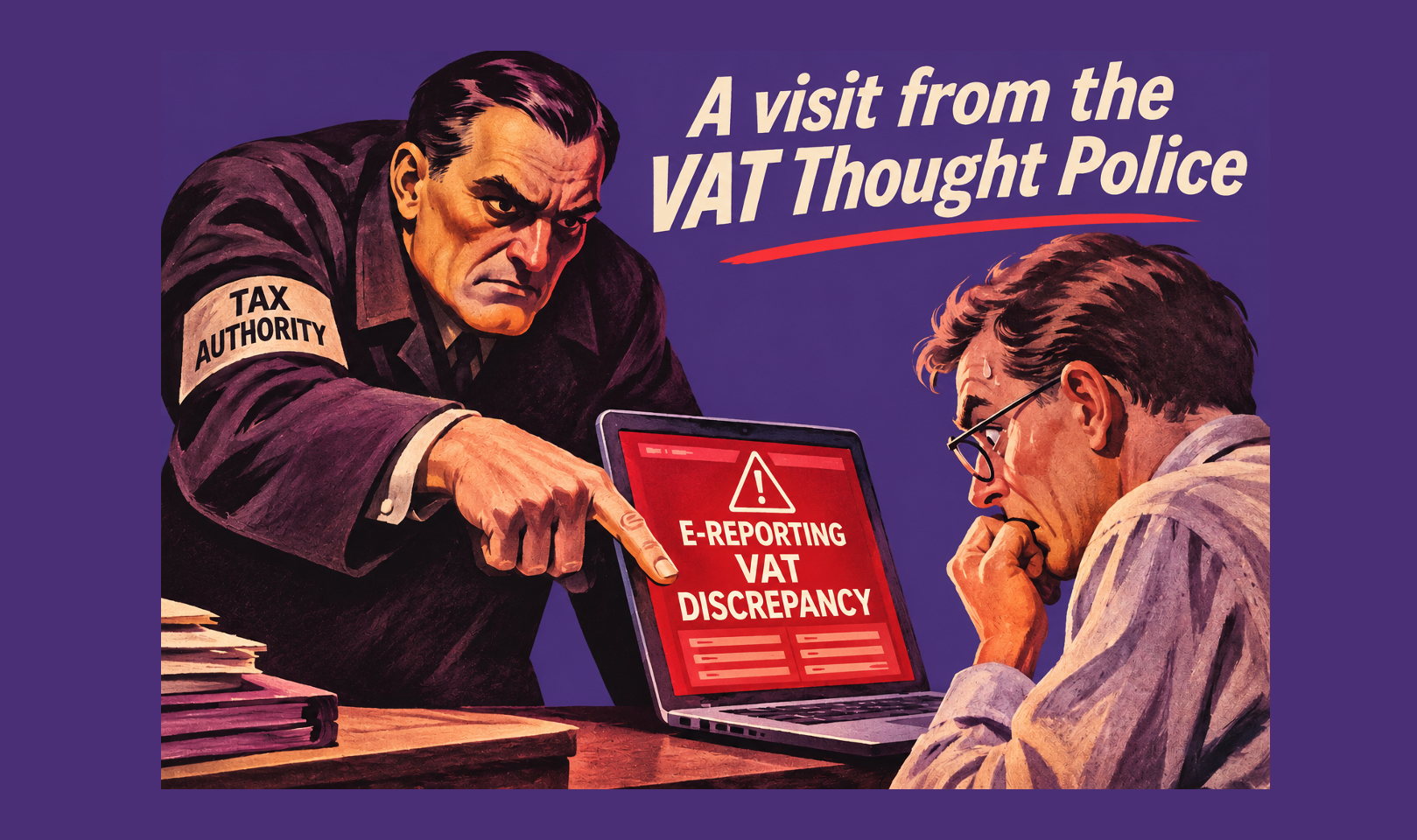
The danger is that algorithmic suspicion becomes a presumption of non-compliance. Guilty until reconciled.
The Ministry of VAT Truth
Pre-filled VAT returns introduce another uncomfortable shift. Rather than the business declaring its VAT liability, the authority increasingly presents its own version of events for the business to reconcile or contest.
What was sold as a convenience risks becoming an instrument for imposing the authority’s interpretation of VAT.
In Orwell’s world, the state determined the truth. We must be careful not to confuse the tax authority’s version of the data with the correct application of the law.
But The Thought Police don’t necessarily understand VAT
Greece is deploying AI in its fight against VAT fraud. A perfectly sensible development by AADE. But complex supply chains, exemptions, reverse charges and national legislative variations routinely produce legitimate anomalies.
Collecting every invoice does not confer an understanding of every transaction. AI may make tax authorities considerably better at spotting the unusual. That is quite different from identifying the unlawful.
Who audits the auditor?
Will businesses have access to the reasoning behind automated challenges and meaningful rights to contest them?
Encouragingly, Belgium’s proposed 2028 VAT e-reporting regime recognises that discrepancies between supplier and customer reporting do not automatically constitute VAT irregularities. The Belgian Chamber of Representatives have a good take on this.
Then there is the economics. Generating thousands of automated challenges costs a tax authority relatively little. Investigating and responding to them could cost businesses considerably more.
Permanent audit was never the bargain
The promise of digital VAT compliance was simplification. Yet we risk retaining existing compliance obligations whilst adding a permanent layer of digital scrutiny.
Digitalisation should replace compliance obligations, not multiply them. And the efficiency gains should be shared between tax authorities and taxpayers.
Otherwise, Big Brother has found himself a very comfortable spare desk.