Tax authorities have almost completed the move to electronic VAT filing
Now they want the underlying transactions, too
The OECD’s new Tax Administration 2026 report provides a fascinating snapshot of how 60 tax jurisdictions are embracing digitalisation, automation and artificial intelligence.

For VAT, one statistic stands out: 98.7% of VAT returns were filed electronically in 2024, compared with 93.6% in 2018 across the jurisdictions reporting comparable data.
So, the battle to digitalise VAT filing is largely won. Tax authorities are now moving upstream, collecting transaction data through e-invoicing and digital reporting, often long before the VAT return arrives. And that’s where things get interesting.
E-invoicing gives tax authorities a front-row seat
The OECD highlights the spread of structured e-invoicing and transaction reporting mandates. These give tax administrations earlier visibility of business activity, helping them detect fraud, identify discrepancies and potentially automate compliance.
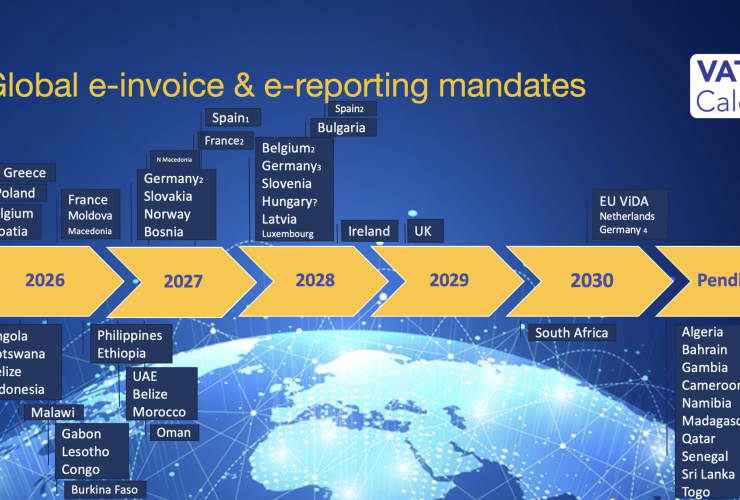
Singapore’s GST InvoiceNow programme is one example. It uses the Peppol network to exchange invoices between businesses while transmitting relevant data to the tax authority. The EU is heading in the same direction through its VAT in the Digital Age reforms, with digital reporting requirements for intra-community transactions from July 2030.
But receiving an invoice is not the same as knowing whether the VAT is correct. An invoice may pass every technical validation while still applying the wrong rate, exemption or reverse charge treatment. Tax authorities are getting more data. Whether they are getting better data is another question.
Pre-filled VAT returns: a solution looking for a problem?
The OECD also examines how tax administrations are using information already in their possession to automate tax calculations and pre-fill returns. China is highlighted for its automated VAT calculations, while Singapore is exploring how electronic invoice data might support pre-filled GST returns.
The attraction for governments is obvious. Why ask businesses to report information the authorities already hold? Unfortunately, VAT is rarely that straightforward.
E-invoice data does not necessarily capture partial exemption adjustments, import VAT, reverse charges or the many other calculations needed to establish a business’s final liability. Businesses must still reconcile the government’s figures against their own records. And when the numbers differ, somebody has to investigate.
Pre-filled VAT returns may be helpful for smaller businesses with straightforward transactions. For larger or more complex taxpayers, they risk creating another set of figures to reconcile. The question is whether this genuinely simplifies compliance or merely moves the work elsewhere.
AI is coming for VAT compliance
The OECD reports that 77% of tax administrations were using artificial intelligence in 2024, up from 29% in 2018. That is quite a leap.
With growing volumes of transactional data, AI gives authorities powerful tools to identify anomalies, compare supplier and customer reporting, and target potential non-compliance. But there is an important distinction between identifying something unusual and establishing that it is wrong.
VAT treatment frequently depends on commercial circumstances, contractual arrangements and legislative interpretation. An algorithm identifying an apparent discrepancy does not necessarily mean the taxpayer has made an error. As tax authorities increasingly automate compliance monitoring, businesses will need transparency over how their data is interpreted and effective opportunities to challenge incorrect conclusions. For instance, see how VATCalc embeds AI into preparing, analysing and reporting VAT, but leaving the calculation to its deterministic tax engine.
Could tax legislation become machine-readable?
One particularly interesting development is the OECD’s work on Rules as Code: expressing legislation in formats that computer systems can interpret and apply. This could be enormously valuable for VAT.
Today, businesses and software providers must translate increasingly complex legislation into the tax rules used by their accounting and compliance systems. Making those rules more accessible and machine-readable could improve consistency, reduce implementation costs and help businesses comply across multiple jurisdictions.
Of course, legislation is not always written with computers in mind. Ambiguities, exceptions and differing national interpretations remain considerable obstacles.
The VAT return isn’t dying. It’s changing jobs.
Perhaps the most important implication of the OECD report is what happens to the traditional VAT return.
As governments collect more information through e-invoicing and digital reporting, the return increasingly becomes a reconciliation statement. Businesses must explain the differences between what the tax authority has received and what their accounting records establish as the correct VAT position.
For multinationals, the challenge is multiplied by the growing number of national reporting systems, each with its own formats, deadlines and validation rules. This is why the next generation of VAT technology needs to do more than calculate tax or transmit electronic invoices. VAT determination, reporting and reconciliation must work together.
The OECD’s report demonstrates how rapidly tax administrations are modernising. But it also raises a question that deserves more attention: are we genuinely simplifying VAT compliance, or just making it happen faster and more frequently?
Digitalising VAT compliance doesn’t eliminate tax complexity. It exposes it.