Leading the responsible use of AI and Agentic AI in VAT technology
- VATCalc leads the market in responsible AI adoption for VAT, embedding AI and agentic AI within a single VAT determination and reporting application governed by codified legislation and expert tax oversight.
- Deep local VAT expertise is central to VATCalc’s AI strategy, ensuring AI reflects how tax authorities actually interpret and apply VAT law in practice—not just how it is written.
- This expert-led approach is critical for cross-border transactions, including triangulation and marketplace models, where multiple jurisdictions, conflicting rules, and divergent enforcement practices apply to the same VAT calculation and return.

AI is reshaping VAT technology, but nowhere are the risks of careless adoption greater than in Value Added Tax. VAT is complex, jurisdiction-specific, frequently amended, and enforced inconsistently across borders. In this environment, AI without governance creates risk rather than value.
VATCalc has emerged as a leader in AI-enabled VAT technology precisely because it recognises this reality. Its approach combines advanced AI and agentic AI capabilities with deep VAT expertise, legislative codification, and continuous human oversight, all embedded within the world’s only single VAT determination and reporting application.
Examples of where VATCalc has been early adopters of AI evidence this:
- Accuracy in item classification. AI can suggest VAT categorisations quickly, but always within the boundaries of expert-maintained global VAT data.
- Confidence in advice. Advisor generates draft guidance that reflects verified content, minimising the risk of hallucinations or incomplete analysis.
- Agentic AI for VAT via our MCP server, AI can retrieve transactions, run VAT determinations, trace legislative rule chains and explain outcomes obligations and reporting on the logic applied within the VATCalc engine
AI Designed to Augment VAT Expertise
VATCalc’s AI strategy is built on a clear principle: AI must support VAT professionals, not replace them. Generic AI models trained on legal texts or unstructured data are prone to error, oversimplification, and false certainty. VATCalc avoids these pitfalls by constraining AI within expert-defined boundaries.
AI within VATCalc supports VAT classification, draft VAT advice, transactional risk identification, and review workflows. Every output is transparent, reviewable, and anchored to verified VAT legislation and logic maintained by VAT specialists.
Recent public examples of where AI use without this tax expertise, such as Big 4 firm embarrassment or invented tax cases.
Agentic AI: Intelligent Orchestration, Not Autonomous Tax Decisions
VATCalc is advancing into agentic AI, where AI agents execute multi-step VAT workflows under expert control. These agents act as digital VAT assistants, coordinating tasks such as:
- Continuous monitoring of transactions for VAT anomalies
- Legislative change tracking and impact analysis
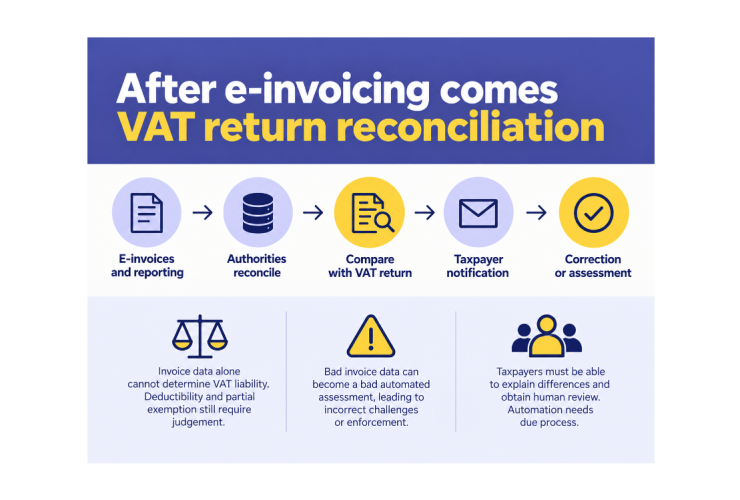
- VAT return preparation and reconciliation
Crucially, agentic AI within VATCalc cannot override legislative logic or submit filings autonomously. Human approval and accountability remain mandatory at every critical stage.
Preventing AI Failure Modes Through Expert Oversight
Eliminating Hallucinations
One of the most dangerous AI risks in tax is hallucination—confident but incorrect legal conclusions. VATCalc prevents this by ensuring AI outputs are anchored to codified VAT law and expert-maintained logic. Where ambiguity exists, AI is prevented from speculating and escalation to VAT experts is required.
Managing Contradictory Cross-Border Rules
Cross-border VAT is inherently contradictory. Even within the EU, Member States interpret and apply the VAT Directive differently. AI-only systems often assume harmonisation where none exists.
VATCalc explicitly prevents this by codifying VAT rules at national level, capturing local deviations and requiring AI to evaluate each jurisdiction independently. There is no automated “averaging” of outcomes across countries.
Understanding How VAT Is Applied in Practice
A critical weakness of AI-only VAT solutions is their reliance on statutory text alone. In reality, the law as written is often not the law as applied. Tax authority guidance, audit practice, and enforcement behaviour materially affect outcomes.
VATCalc’s VAT experts embed this practical knowledge into the platform, ensuring AI outputs reflect how transactions are likely to be assessed in audits—not just how the legislation reads. This distinction is essential for producing VAT positions that are operationally defensible.
Triangulation and Marketplaces: Where AI-Only Models Fail
Triangulation and marketplace transactions demonstrate why VAT cannot be scaled through legal text alone. Triangulation, while conceptually harmonised, is applied inconsistently across Europe. Tax authorities differ on eligibility conditions, invoice wording, documentation requirements, and tolerance for complex supply chains. Case law and administrative guidance have further narrowed practical application in some jurisdictions. AI-only systems often conclude that triangulation “should apply”, ignoring the reality that certain authorities routinely deny it in practice.
Marketplaces and platforms present similar challenges. Definitions of deemed supplier status, facilitation versus intermediation, evidentiary thresholds, and liability differ widely across countries. Enforcement intensity and audit focus also vary significantly.
VATCalc’s expert-governed AI captures these nuances, ensuring that cross-border determinations reflect both legal entitlement and enforcement reality.
Governance, suditability, and control by design
Every AI and agentic AI function within VATCalc is governed by principles that matter to tax leaders, auditors, and regulators:
- Full traceability of outputs
- Clear linkage to legislative and administrative sources
- Mandatory human oversight
- Audit-ready determination and reporting logic
AI strengthens control rather than undermining it.
Tax expert orchestrated AI intelligence
VATCalc demonstrates that the future of VAT technology is not autonomous AI, but expert-orchestrated intelligence. By combining AI and agentic AI with legislative rigour, deep local knowledge, and a single determination and reporting platform, VATCalc delivers innovation without risk.
In a world of accelerating VAT digitalisation and shrinking tolerance for error, VATCalc shows that responsible AI is not a constraint—it is a competitive advantage.