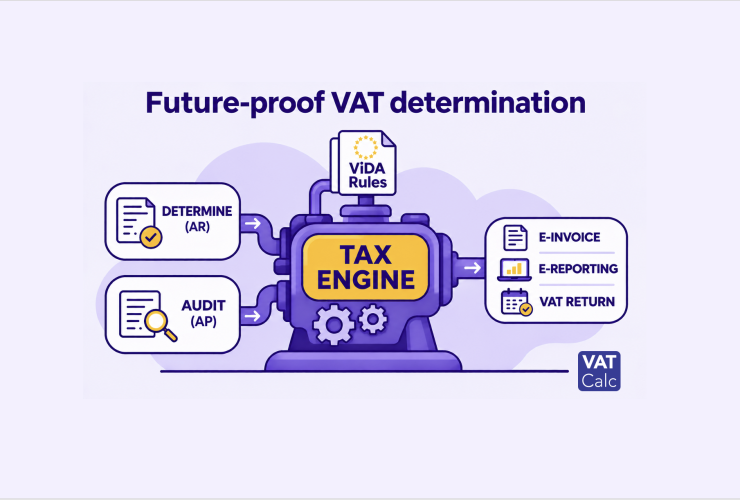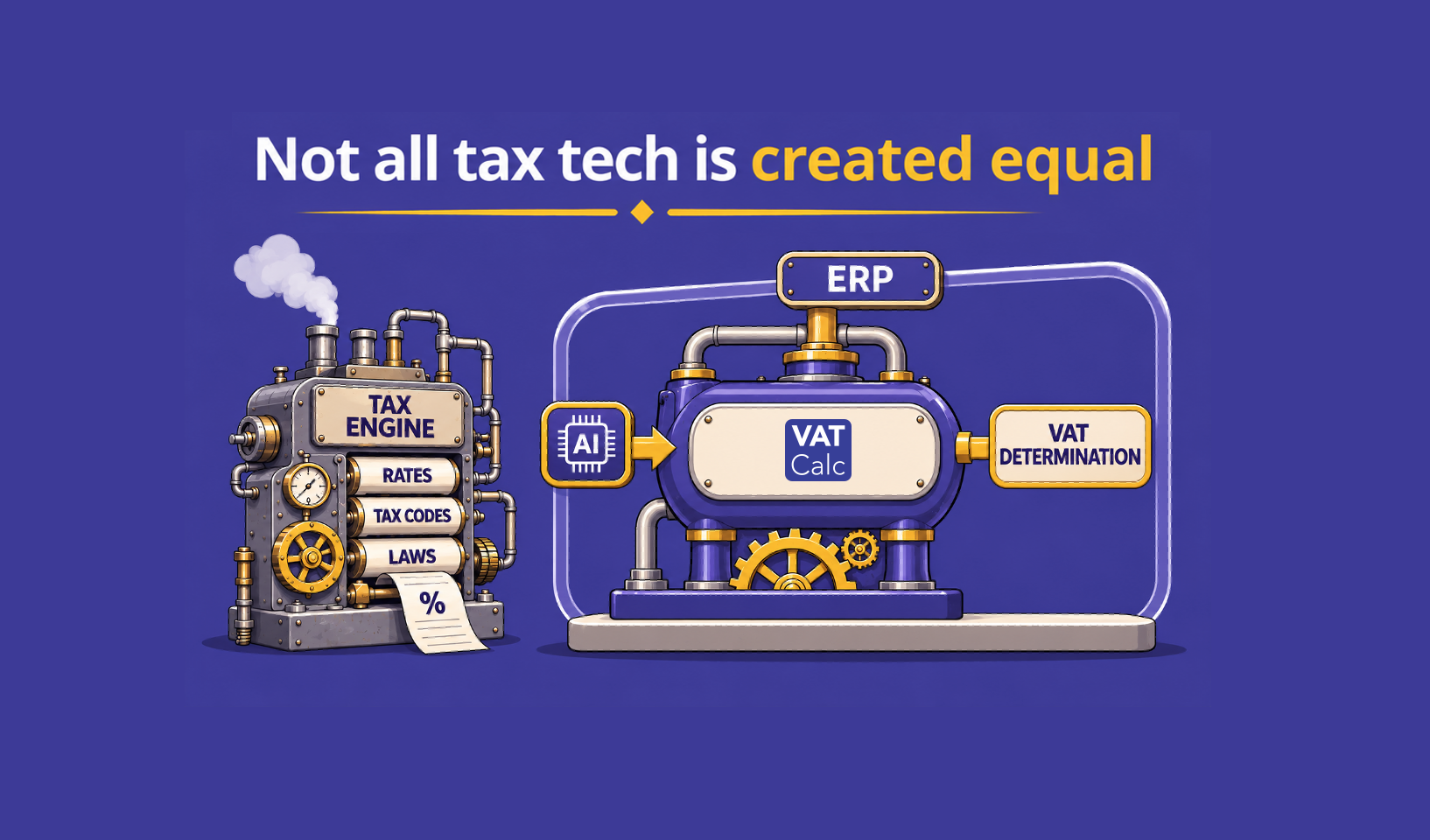
As global tax technology providers invest in AI, e-invoicing and connected compliance, VATCalc takes a different approach:
One legislative-coded VAT engine, integrated compliance applications and a platform designed for embedding.
Global VAT technology is undergoing a fundamental transformation.
Traditional indirect tax software focused on calculating tax at the point of sale or preparing periodic VAT returns. Today, businesses also need e-invoicing, real-time reporting, transaction auditing, automated classification and reconciliation.
The EU’s VAT in the Digital Age (ViDA) reforms are accelerating this transition.
The major providers — Vertex, Avalara, Sovos and Thomson Reuters — are responding with broader platforms and increasingly sophisticated artificial intelligence.
But important differences remain in how these systems determine VAT, validate transactions and connect tax calculations to compliance reporting.
Comparing the five VAT technology providers
The following comparison considers their published capabilities as of November 2026.
| Capability | VATCalc | Vertex | Avalara | Sovos | TR |
| Global VAT/GST determination | ✅ | ✅ | ◐ | ◐ | ◐ |
| Global VAT return preparation | ✅ | ✅ | ✅ | ✅ | ✅ |
| E-invoicing and digital reporting | ✅ | ✅ | ✅ | ✅ | ✅ |
| AI product/item classification | ✅ | ✅ | ✅ | ✅ | ✅ |
| AI-assisted data mapping | ✅ | ✅ | ✅ | ✅ | ✅ |
| Transaction-level VAT auditing | ✅ | ◐ | ◐ | ◐ | ◐ |
| Legislative references supporting VAT determination | ✅ | ◐ | ◐ | ◐ | ◐ |
| Determination, auditing and filing using the same legislative-coded engine | ✅ | ◐ | ◐ | ◐ | ◐ |
| Integrated e-invoice/return reconciliation | ✅ | ◐ | ◐ | ◐ | ◐ |
| AI-assisted compliance workflows | ✅ | ✅ | ✅ | ✅ | ✅ |
| Embedded/API deployment | ✅ | ✅ | ✅ | ✅ | ✅ |
1. Tax calculation is not the same as VAT determination
The distinction between calculating VAT and determining the correct VAT treatment is frequently overlooked.
Once the applicable tax treatment has been established, calculating VAT may be straightforward. However, international transactions require decisions about place of supply, liability, exemptions, reverse charges and other legislative obligations before a rate can be applied.
For example, Sovos markets a Global Tax Determination product covering VAT, GST, excise and sales taxes across more than 185 countries and jurisdictions. Its published functionality includes tax rates, product codes, rules and real-time calculations.
These capabilities are valuable, but extensive geographical coverage and tax-rate libraries do not, by themselves, demonstrate comprehensive legislative-driven VAT determination across complex international transactions.
The distinction also matters when comparing other providers, whose determination capabilities vary by product and jurisdiction.
VATCalc Calculator is designed to establish the correct VAT treatment from the underlying transaction facts, applying codified legislation covering cross-border supplies, exemptions, reverse charges and other obligations.
Its determinations are supported by legislative references, providing an auditable explanation of the tax treatment.
The key question is not how many tax rates a system supports, but whether it can establish why VAT is chargeable, where and by whom.
2. Embedded VAT technology: integration is not embedding
Most major tax technology providers offer APIs and ERP integrations. However, connecting a standalone tax application to an ERP differs from embedding comprehensive VAT compliance capabilities directly within another software provider’s product.
This distinction matters for ERP vendors, accounting platforms, e-invoicing providers and financial technology businesses. They increasingly want to offer international VAT compliance without maintaining their own legislative content, determination rules and reporting applications.
VATCalc’s API-first, serverless architecture was designed for this model. Partners can embed individual applications or the complete platform, including:
- Calculator: International VAT/GST determination.
- Filer: VAT returns, digital reporting and statutory compliance.
- Auditor: Independent transaction-level VAT re-determination.
- Advisor: VAT classification and treatment guidance.
AI Item Classification and AI Mapping Studio extend these capabilities, while white-label deployment allows partners to retain their branding and customer relationships.
The November 2026 Sage–Sovos announcement illustrates the growing demand for embedded tax technology. Sage Intacct now offers Sovos-powered US sales tax determination and exemption certificate management within its financial workflows.
However, this announced integration is limited to US sales tax. It is not an equivalent embedded international VAT determination, auditing and reporting platform.
VATCalc offers partners the ability to incorporate these broader international VAT capabilities into their existing software, either independently or as a connected compliance solution.
For software vendors, the commercial opportunity is significant: offer sophisticated global VAT compliance without becoming VAT software developers themselves.
3. One legislative-coded engine across determination and auditing
All the major providers offer multiple indirect tax applications. The distinction is whether those applications share the same underlying tax logic or rely on separate determination, validation and reporting processes.
Consider a business issuing an invoice using its ERP’s configured tax code. The transaction is subsequently transmitted through an e-invoicing provider and included in a VAT return prepared by another application.
Each stage may function correctly, but an incorrect original VAT treatment can pass through the entire process without being challenged.
VATCalc uses the same legislative-coded engine across its determination and auditing applications. Calculator establishes the original VAT treatment, while Auditor can independently re-determine transactions processed by an ERP, another tax engine or an external supplier.
This enables businesses to identify incorrectly charged purchase VAT, inappropriate exemptions, reverse-charge errors and other discrepancies before they create reporting problems.
The independent nature of this process is particularly important. VATCalc Auditor does not require the original calculation to have been performed by VATCalc.
Filer then supports statutory reporting and reconciliation using the same underlying tax logic, rather than simply accepting the original ERP tax treatment.
Reconciliation establishes whether the numbers agree. Independent VAT re-determination helps establish whether those numbers are correct.
4. AI Item Classification: beyond product mapping
Artificial intelligence is becoming an important component of indirect tax compliance, particularly in product and service classification.
In November 2026, Avalara launched Intelligent Tax Classification, using AI to interpret product descriptions and recommend tax codes. The solution includes confidence scoring, approval workflows and API-based processing.
Other providers are also investing in AI-assisted classification, data mapping and compliance automation.
VATCalc’s AI Item Classification addresses this challenge within its wider legislative-coded platform. It interprets goods and services descriptions and supports the appropriate classification of transactions, reducing dependence on manually maintained product mappings.
Importantly, this capability is not confined to sales tax calculations. Classification can support VAT determination, purchase invoice validation, independent auditing and subsequent compliance reporting.
For example, unfamiliar goods or services appearing on supplier invoices can be classified before Auditor independently assesses the VAT treatment.
VATCalc’s Mapping Studio also uses AI to transform ERP data into the structures required for automated determination and reporting, while VAT Copilot provides a natural-language interface for compliance workflows.
These technologies support the underlying legislative engine rather than replacing tax determination with generative AI. This preserves the consistency and explainability required for tax decisions while reducing manual implementation and compliance work.
5. E-invoicing and continuous compliance: technical validity is not enough
The established providers are increasingly connecting tax determination, e-invoicing and reporting.
In October 2026, Vertex introduced Sōl, a connected compliance platform designed to bring tax decisions, workflows and audit evidence together. Thomson Reuters has incorporated Pagero into its ONESOURCE portfolio, while Sovos and Avalara continue expanding their digital compliance capabilities.
These developments reflect the move from periodic VAT reporting towards continuous transaction-level compliance, accelerated by the EU’s VAT in the Digital Age reforms.
However, connecting or just buying compliance processes does not automatically establish that the underlying VAT treatment is correct.
An e-invoice can satisfy every technical validation requirement while applying an incorrect exemption, reverse charge or place-of-supply rule. Similarly, a VAT return can reconcile with the accounting records while reproducing the same original tax errors.
This is the emerging distinction between technical compliance and tax accuracy.
VATCalc combines within one platform (so no multiple integrations and hand-offs) legislative determination, independent transaction auditing and reporting to address both requirements. Its common tax engine enables businesses to examine the original tax decision rather than simply validating the data transmitted between systems.
As tax authorities gain greater visibility over individual transactions, businesses will increasingly need to explain not only what was reported, but why the VAT treatment was correct. This is why VATCalc has provided unique e-reconciliation functionality, which automatically reconciles e-invoices to VAT returns. This becomes more vital as tax authorities move towards pre-filled VAT returns.
The next generation of VAT technology
Vertex, Avalara, Sovos and Thomson Reuters are investing heavily in connected compliance, AI and e-invoicing. These developments demonstrate where the indirect tax technology market is heading.
VATCalc offers a different architectural proposition: a single legislative-coded engine supporting determination and auditing, integrated compliance applications, and modular technology that software partners can embed within their own products.
As digital reporting obligations expand, the competitive advantage will increasingly lie in the ability to establish, validate and explain the underlying tax treatment.
Digitalising VAT compliance doesn’t eliminate tax complexity. It exposes it.
The next generation of VAT technology must do more than automate compliance. It must get the tax right in the first place.