Cyprus sets VAT and Customs agenda for EU Council Presidency (Jan–June 2026)
-
Tax transparency and simplification accelerate: Cyprus will push forward reforms on administrative cooperation, the EU blacklist, VAT anti-fraud cooperation, and a new omnibus simplification package for direct taxes.
-
Indirect tax and climate measures move closer to delivery: Progress is expected on import VAT distance sales, the Tobacco Taxation Directive, and agreement on Carbon Border Adjustment Mechanism (CBAM) implementation.
-
Customs reform reaches a political milestone: The Presidency aims to conclude trilogue negotiations on the 2028 EU Customs Reform Package, including the new Union Customs Code and European Union Customs Authority.
First six months of 2026 Cyprus to progress VAT and customs program
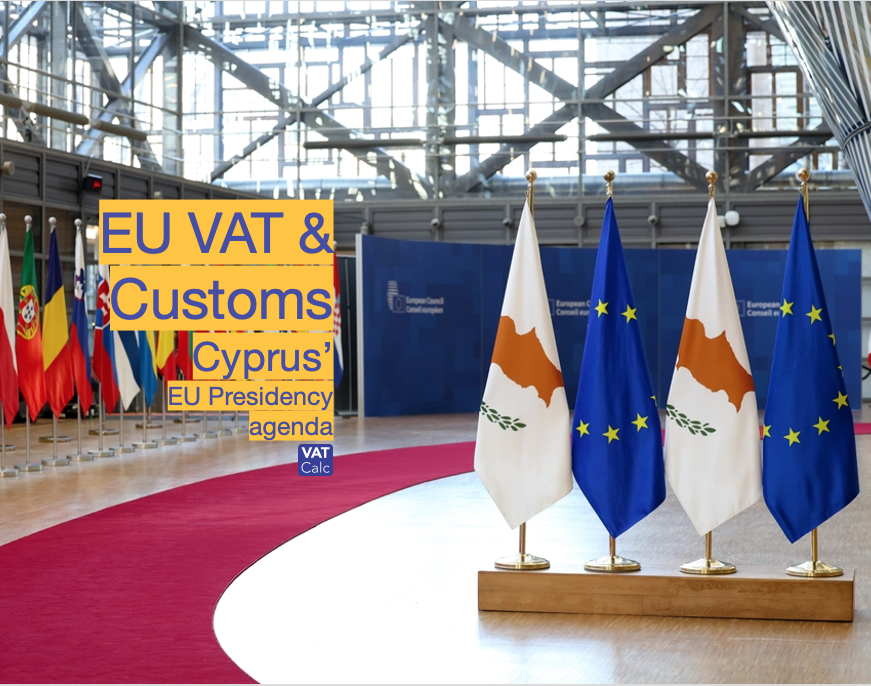
From 1 January to 30 June 2026, Cyprus will hold the Presidency of the Council of the European Union at a critical moment for tax administration modernisation, customs reform, and climate-driven fiscal policy. The agenda reflects a dual objective: strengthening tax integrity and enforcement across the Single Market while simplifying regulatory burdens to preserve EU competitiveness.
The programme aligns closely with broader EU priorities already underway, including enhanced administrative cooperation, digitalisation of tax controls, the evolving VAT anti-fraud framework, and the structural overhaul of the EU Customs Union.
Indirect tax: VAT, excise, and CBAM momentum
The Presidency’s indirect tax agenda is equally substantial and operationally impactful for multinational businesses.
-
VAT on distance sales of imported goods and import VAT
Cyprus intends to conclude the technical work on revising the proposal covering VAT rules for distance sales of imported goods and import VAT. This links directly to the EU’s broader objective of tightening VAT collection on e-commerce flows while simplifying compliance models.
-
Revision of the Tobacco Taxation Directive
Work will continue on updating excise frameworks to reflect public health policy, inflation dynamics, and cross-border distortions.
-
Carbon Border Adjustment Mechanism (CBAM)
The Presidency will intensify work on cross-sectoral issues arising from CBAM implementation, assessing legal, financial, economic, and political feasibility of proposed solutions. The aim is to progress toward a General Approach, providing greater regulatory certainty for affected supply chains.
-
Future proposals on VAT administrative cooperation and anti-fraud
Cyprus stands ready to begin work on forthcoming proposals to strengthen administrative cooperation and combat VAT fraud, reinforcing the EU’s digital reporting and ViDA real-time compliance trajectory.
Customs Union reform: political agreement targeted
Customs reform represents one of the most strategically significant files under the Cyprus Presidency.
The Presidency has stated that reform of the EU Customs Union is a priority, with the explicit objective of concluding trilogue negotiations and achieving a political agreement on the Customs Reform Package. This includes:
-
A new Union Customs Code, and
-
The establishment of a European Union Customs Authority.
If achieved, this would mark a structural transformation of EU customs governance, centralising risk management, improving data harmonisation, and modernising enforcement capabilities across borders. The reform also supports future alignment with VAT collection, product safety controls, and climate measures such as CBAM.
Pragmatism to progress well developed tax program
Cyprus’ Presidency programme reflects pragmatic ambition: advancing politically complex reforms while laying the groundwork for long-term simplification and digital enforcement. If momentum is maintained on customs reform, VAT anti-fraud cooperation, CBAM implementation, and administrative cooperation recasts, 2026 could become a decisive year in reshaping how tax and customs operate across the Single Market.