Progress on semantics and core content undermined by national execution differences
The rapid global expansion of e-invoicing and e-reporting mandates promises a more harmonised digital tax environment.
Standards such as the EU’s EN 16931 were intended to improve interoperability by creating a common semantic model for invoice data across borders.

Interoperability blocked by national execution
Yet for businesses operating internationally, interoperability remains one of the largest implementation challenges. Multinationals, exporters and fast-growing mid-sized businesses are increasingly confronted with fragmented country requirements, differing tax-control models, transactions in scope, local infrastructure requirements (extremely painful for multinational businesses) and incompatible technical implementations.
While governments may share similar digital VAT objectives, they are often implementing them in very different ways. This comes despite the work on EU ViDA and the partial harmonisation of intra-community Digital Reporting Requirements and the OECD e-invoicing guidance. Examples abound: even in the EU, with harmonisation via ViDA’s DRR we see countries like Netherlands leave out B2C, but countries like France and Romania include it. And countries are erratic in selection of pre-clearance, 4-corner or 5-corner transmission models as the waver on Continuous Transaction Control aims.
Common semantics, different implementations
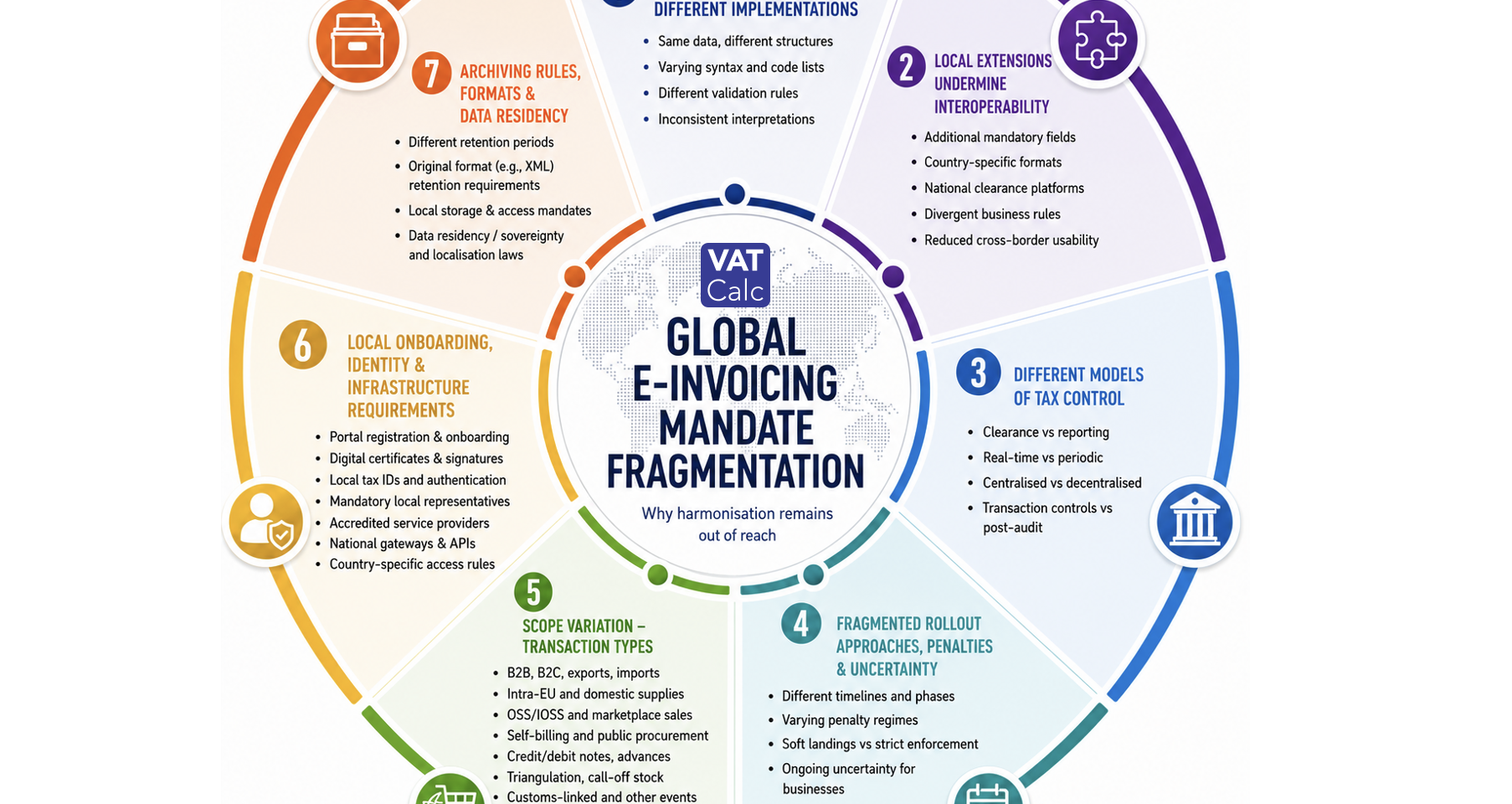
At the centre of European harmonisation efforts is EN 16931, the common semantic model for e-invoices. It defines the meaning of invoice data, including VAT identifiers, invoice lines, tax subtotals and payment information.
However, EN 16931 does not define how invoices must technically be written or exchanged. Countries and networks continue to diverge on syntax, implementation rules and transmission methods.
For example:
- Peppol BIS Billing uses UBL XML syntax
- Factur-X and ZUGFeRD typically use CII syntax
- FatturaPA uses Italy’s domestic XML schema
The result is that countries may align on invoice semantics while still creating different technical ecosystems.
Local extensions undermine interoperability
Many countries also apply local CIUS (Core Invoice Usage Specification) extensions. These introduce domestic mandatory fields, validation rules and tax identifiers beyond the core EN 16931 model.
Examples include:
- domestic tax references
- procurement identifiers
- sector-specific fields
- local payment references
- mandatory buyer identifiers
As a result, an invoice valid in one country may fail validation in another despite both claiming EN 16931 alignment.
Different models of tax control
Perhaps the greatest divergence lies in the tax-control objectives themselves.
Some countries focus on structured invoice exchange. Others prioritise transaction reporting, clearance validation or pre-filled VAT return generation.
Examples include:
- Belgium focusing heavily on Peppol exchange
- Poland’s KSeF central clearance model
- Spain’s real-time reporting-oriented SII
- France’s hybrid e-invoicing and e-reporting architecture, with obligation to appoint a approved e-invoicing service provider
- Italy’s fully integrated clearance ecosystem via SdI
Increasingly, mandates extend beyond invoicing into:
- e-reporting
- SAF-T
- ledger reporting
- pre-filled VAT returns
- transaction reconciliation
- audit controls
This creates fundamentally different compliance operating models between jurisdictions.
Fragmented rollout approaches
Operational rollout models also vary significantly
Countries phase mandates differently according to:
- B2G, B2B or B2C transaction scope
- domestic or cross-border transactions
- taxpayer size thresholds
- invoice volume thresholds
- industry sectors
Governments also diverge on:
- soft-landing periods
- delayed penalties
- buyer liability
- invoice deductibility restrictions
- validation tolerances
Diverging data security and archiving rules
Countries are also introducing differing requirements around:
- data residency
- invoice storage
- archival formats
- retention periods
- audit accessibility
- encryption and digital signatures
Some mandates require invoice data or tax data to be stored locally within national borders or made immediately accessible to tax authorities upon request.
This is becoming increasingly relevant in Gulf Cooperation Council (GCC) countries, parts of Latin America and emerging real-time reporting regimes.
Countries also diverge on:
- whether structured XML becomes the legal invoice
- whether PDF copies remain relevant
- mandatory hash chains
- cryptographic stamps
- QR code validation
- continuous audit logging
As a result, businesses cannot assume that a compliant storage or security model in one jurisdiction will satisfy another.
Local onboarding and infrastructure barriers
Another growing source of fragmentation, especially for non-resident and multinational businesses, is the rise of country-specific onboarding and access requirements for digital VAT platforms.
Increasingly, non-resident businesses must navigate:
- local portal registrations
- domestic authentication systems
- digital certificates and electronic signatures
- accredited local service providers (an obligation for France)
- national API gateways
- fiscal representatives or local intermediaries
In some jurisdictions, access to clearance or reporting platforms may depend on local tax identifiers, domestic credentials or country-specific onboarding procedures.
These operational requirements create additional barriers for multinational groups seeking centralised ERP, invoicing and compliance models.
The challenge for businesses is therefore no longer limited to invoice formatting or reporting schemas. It increasingly involves access to national digital tax infrastructures themselves.
Harmonised semantics, fragmented execution
The global move toward digital VAT controls is undoubtedly accelerating harmonisation at the semantic layer of invoicing.
But fragmentation increasingly exists elsewhere:
- syntax
- exchange networks
- APIs
- clearance architectures
- reporting obligations
- rollout sequencing
- enforcement models
- security and archiving requirements
For businesses, the challenge is no longer simply generating an electronic invoice. It is managing an expanding landscape of country-specific digital tax ecosystems with differing operational, technical and compliance requirements.