Action Plan for centralised tax data, VAT real-time domestic (tbc) reporting and artificial intelligence to identify tax fraud
Digital VAT reforms announced by the Federal Finance Minister and the Federal Justice Minister on 16 July 2026.
The proposals could mark change in Germany’s approach to digital VAT enforcement. Its fragmented federal tax administration has previously made it difficult to establish the kind of national database already used by several other European tax authorities.

Central tax data platform to open up e-reporting
A new data analysis centre will be established to consolidate tax information on a central platform. Federal and state authorities will be given greater access to shared data, while AI-supported analytical tools will identify suspicious patterns across large financial datasets.
This centralisation is particularly significant in Germany, where tax administration is largely managed by the 16 federal states.
Germany has historically lacked the single national VAT data infrastructure found in countries such as Italy and Hungary. Bringing federal and state data together could provide the technical and administrative foundation needed for more extensive digital VAT reporting.
Laying the foundations for domestic VAT e-reporting?
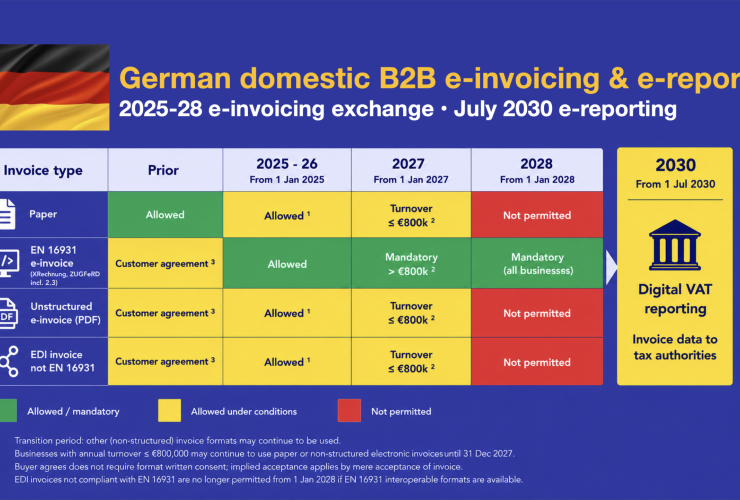
The action plan also commits Germany to introducing a VAT real-time reporting system. Germany phased e-invoicing mandate started in 2025 and completes the end of 2027.
The government document refers to transactions being reported individually and promptly, allowing VAT carousel fraud to be detected more quickly. This appears potentially broader than the EU’s ViDA Digital Reporting Requirements, which will apply mainly to intra-EU B2B transactions from 1 July 2030.
Germany has not yet confirmed whether its proposed system will cover domestic transactions. No implementation timetable, reporting format or technical architecture has been published.
However, the combination of mandatory domestic B2B e-invoicing, a central tax data platform and real-time transaction reporting suggests Germany may be laying the groundwork for domestic VAT e-reporting.
A phased European digital reporting model
Germany’s apparent direction follows an emerging European implementation model: establish structured e-invoicing first, then add tax authority reporting and analytics.
- Belgium made structured domestic B2B e-invoicing mandatory from 1 January 2026. It is expected to add real-time transactional reporting from 2028 through a Peppol five-corner model.
- The Netherlands is considering a similar, deliberately phased approach. Current proposals envisage domestic B2B e-invoicing around 2030, followed by domestic digital reporting at a later stage, potentially around 2032. Final decisions have not yet been taken.
- France’s has gone different with a more ambitious big-bang reform. From September 2026, France is combining mandatory e-invoicing, e-reporting and a new accredited-platform ecosystem within the same launch programme.
AI also needs centralised data
AI is the headline feature of the German enforcement plan, but the central database may be the more important development.
AI tools cannot identify missing-trader networks or VAT carousel patterns effectively where information remains divided between separate authorities. The proposed platform would allow Germany to analyse transactions across state borders and combine VAT data with intelligence held by customs and financial investigators.
The government also plans to establish a Joint Centre Against Tax and Financial Crime within the customs authority, bringing together federal and state investigators.
The emerging architecture is appears to be:
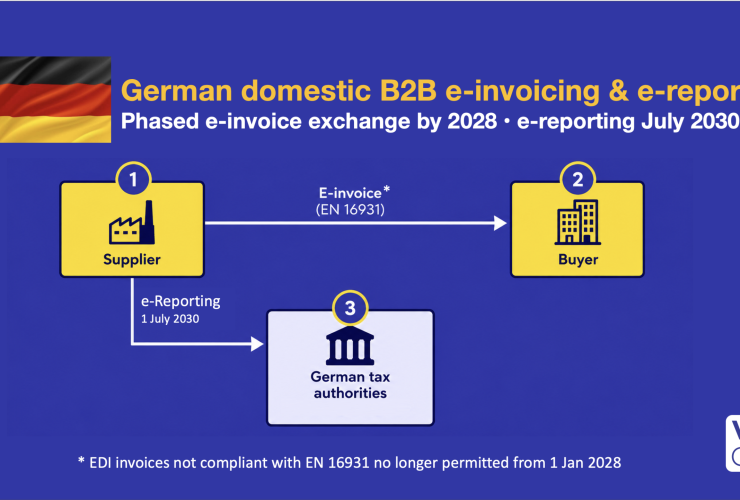
- Structured e-invoices create the data
- Real-time reporting delivers it to the tax authority
- A central platform combines it
- AI identifies the risks.
AI is therefore not replacing conventional VAT controls. It is the intelligence layer operating above a much broader digital compliance architecture.
More extensive data controls
Other measures will strengthen the information available to the authorities.
Accounting record retention periods would be extended to 15 years. Businesses from outside the EU would be required to store and retain tax-relevant information on mirror servers in Germany, addressing difficulties accessing data held overseas.
Mandatory registered cash systems would also be introduced in cash-intensive sectors to combat manipulation and undeclared sales.
Enforcement would be strengthened through expanded controls, more targeted federal tax audits and prison sentences of up to 15 years for particularly serious organised tax crime.
Adoption by tax authorities of AI tools is well underway around the world. Tax authorities are increasingly using AI to analyse transactional data, identify inconsistencies and prioritise investigations.
Tougher enforcement beyond VAT
The reforms extend well beyond VAT.
Germany plans to establish a Joint Centre Against Tax and Financial Crime to coordinate investigations between customs and state tax investigators. Penalties for serious organised tax crime will also increase substantially, with prison sentences of up to 15 years proposed.
The government also intends to abolish the current voluntary disclosure regime that can provide immunity from prosecution for taxpayers who come forward before detection.
International cooperation will also be strengthened through closer working with the European Public Prosecutor’s Office and other cross-border enforcement bodies.
VATCalc insight – tax authorities’ AI ramps up pressure for taxpayers
At VATCalc, we see AI as an important tool for helping businesses manage VAT compliance. But the compliance decision itself must remain grounded in legislative-coded tax logic, providing the transparency and auditability that both businesses and tax authorities increasingly expect.
Germany’s latest proposals reinforce that direction of travel. The question is no longer whether AI will be used by tax authorities to combat VAT fraud, but how quickly businesses can adapt to an increasingly real-time, data-driven compliance environment.
See how VATCalc is applying Artificial Intelligence since 2022 to enhance VAT determination and reporting:
- AI Copilot to help manage work and uncover issues
- AI and item classification in VAT determination;
- Tax advice generated by AI from our VAT expert-maintained tax engine
- Tax code mapping with AI to reduce significantly tax engine implementations and testing