AI can help with VAT compliance. But should it be trusted to determine tax liabilities?
Artificial intelligence can write poetry, diagnose diseases, pass professional examinations and apparently threaten the future of civilisation.

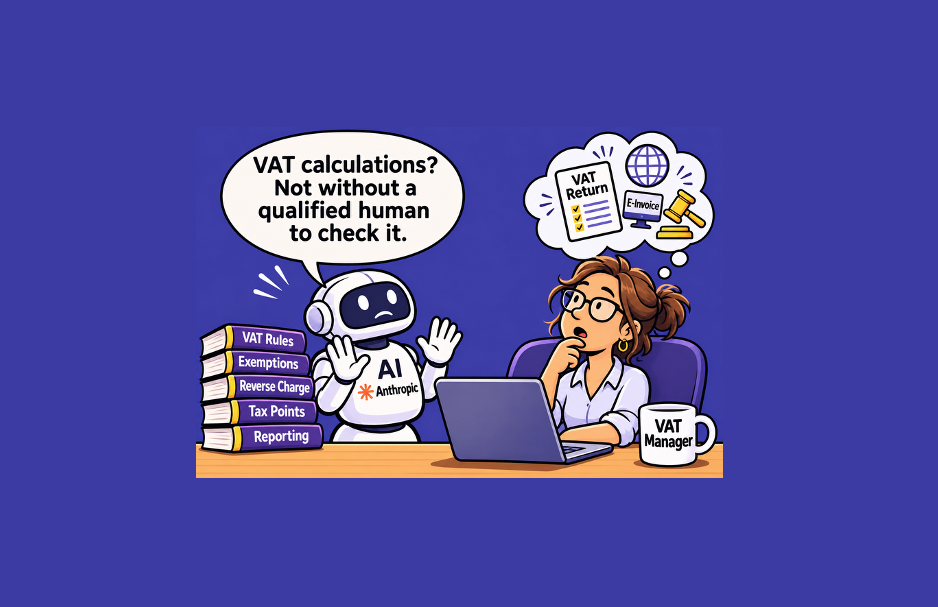
But ask it to prepare your tax return, and even its creators start looking for a qualified human to check the answers.
In its updated Usage Policy, effective 12 November 2026, Anthropic, developer of Claude, explicitly identifies tax advice and tax return preparation as high-risk AI applications requiring qualified human oversight. This reflects a similar OpenAI warning on tax compliance.
The requirements aren’t entirely new, but their clarification raises an interesting question for businesses considering generative AI for VAT determination and reporting.
If AI developers insist on human safeguards for tax advice, should businesses really entrust millions of VAT calculations to generative AI?
The problem with almost getting VAT right
VAT determination is not a prediction exercise. It requires applying legislation to individual transactions, considering place of supply, exemptions, reverse charges, tax points, rates and national variations.
An AI model might confidently explain why a transaction qualifies for zero-rating. Unfortunately, the tax authority may be considerably less impressed if that explanation is wrong.
Even 99% accuracy sounds rather less impressive when applied to a million transactions. That’s potentially 10,000 incorrect VAT determinations.
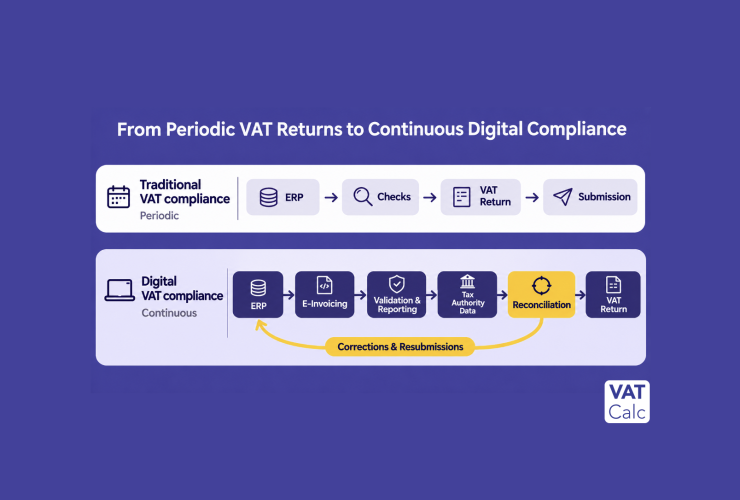
And with tax authorities increasingly accessing transaction-level data through e-invoicing and digital reporting, those errors are becoming easier to identify.
AI is an excellent assistant. But should it be your tax engine?
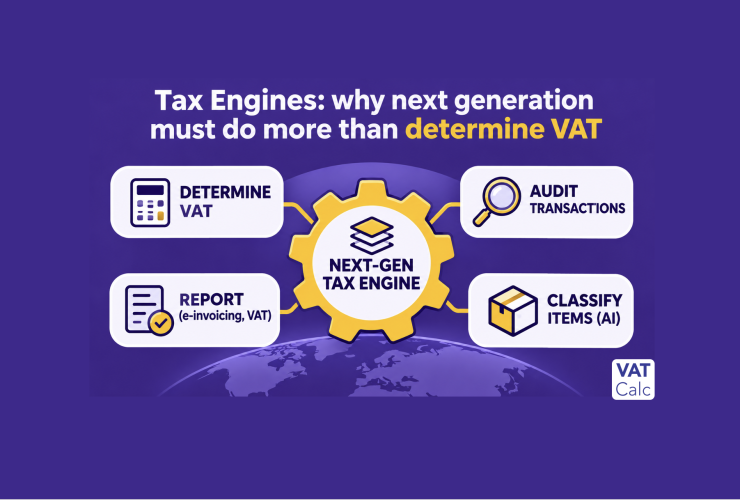
Generative AI has enormous potential in indirect tax. AI item classification, transaction interpretation, data mapping, anomaly detection and compliance analysis can all benefit from its capabilities.
But there is a fundamental difference between interpreting a transaction and determining its legally correct VAT treatment.
The former benefits from AI’s flexibility. The latter requires controlled legislative rules, consistent calculations, reproducible outcomes and a defensible audit trail.
AI should interpret transactions. A deterministic tax engine should determine the VAT.
This is the approach adopted by VATCalc in AI, combining AI-powered item classification and data interpretation with a legislation-driven global tax engine. AI helps establish what a transaction is. The tax engine determines how it must be taxed and reported, including VAT returns and digital reporting obligations.
Who takes responsibility when AI gets VAT wrong?
Anthropic’s policy specifically addresses recommendations affecting individuals, not automated corporate VAT systems. It doesn’t prohibit AI-powered VAT determination.
Nevertheless, its underlying warning deserves attention. As VAT compliance becomes increasingly automated, businesses must still demonstrate that their calculations are accurate, explainable and legally defensible.
And responsibility for incorrect VAT doesn’t disappear simply because an algorithm made the decision.
The future of tax technology isn’t AI replacing tax engines. It’s AI making properly designed tax engines more powerful.
Perhaps the greatest irony is that one of the world’s leading AI developers has reminded us why tax compliance is too important to leave entirely to AI.