E-invoicing promises less administration
In practice, VAT compliance is shifting from periodic return preparation towards continuous reporting, validation, reconciliation and correction

E-invoicing was supposed to make VAT simpler
Reduced administrative burden is one of the principal arguments for e-invoicing. Structured invoices should eliminate manual processing, improve data quality and ultimately make VAT reporting easier.
That remains a credible destination. Getting there is proving rather less simple.
France, Poland and other recent mandates demonstrate that e-invoicing is not merely replacing PDFs with structured data. It is inserting another compliance layer between the ERP, invoice exchange, tax authority and VAT return.
The hidden workload
Businesses face growing national variations despite the harmonisation promised under ViDA. France requires additional reporting data and accredited platforms, while Poland’s KSeF introduces authentication, permissions and procedures for issuing invoices when the central system is unavailable.
Spain provides another example. Its forthcoming mandate includes reporting invoice acceptance and payment status, with certain updates required within four days. Compliance therefore continues well after an invoice has been issued.
Hybrid formats add further complications. Businesses must ensure the structured XML agrees with the human-readable PDF, while maintaining controls over invoices rejected by platforms or tax authorities.
Each requirement may be manageable individually. Together, they make the proposition that e-invoicing automatically reduces administration rather optimistic.
A valid e-invoice is not necessarily correct for VAT
Germany’s latest guidance exposes a particularly revealing problem.
An e-invoice can pass technical validation while containing incorrect VAT treatment. Equally, Germany has clarified that passing a technical validator is not necessarily a condition for VAT recognition.
The distinction matters. Invoice validation checks formats, mandatory fields and business rules. It cannot establish whether the underlying transaction has been classified correctly for VAT, whether an exemption applies or whether the reverse charge should have been used.
A technically valid invoice is not necessarily a VAT-correct invoice.
This leaves businesses managing two separate controls: whether an invoice meets technical requirements and whether its tax treatment is correct.
Pre-filled VAT returns move the work upstream
The next stage is the widespread adoption of pre-filled VAT returns based on e-reporting.
Tax authorities increasingly want to use transaction data to prepare or validate VAT returns. Hungary’s eVAT system already draws on invoice, cash register and customs data, illustrating how governments are building their own transaction-level records.
That sounds like less work for taxpayers. It can be, but only if the government’s data agrees with the business’s.
Instead of preparing a return solely from its accounting records, a business may need to identify why its ERP, transmitted invoices, government records and pre-filled return do not agree.
Errors in master data, VAT classification, tax points or subsequent adjustments can create discrepancies across these systems. The VAT team must then determine which record is correct and how the others should be corrected.
Less return preparation can mean more reconciliation.
From preparing a return to managing a compliance cycle
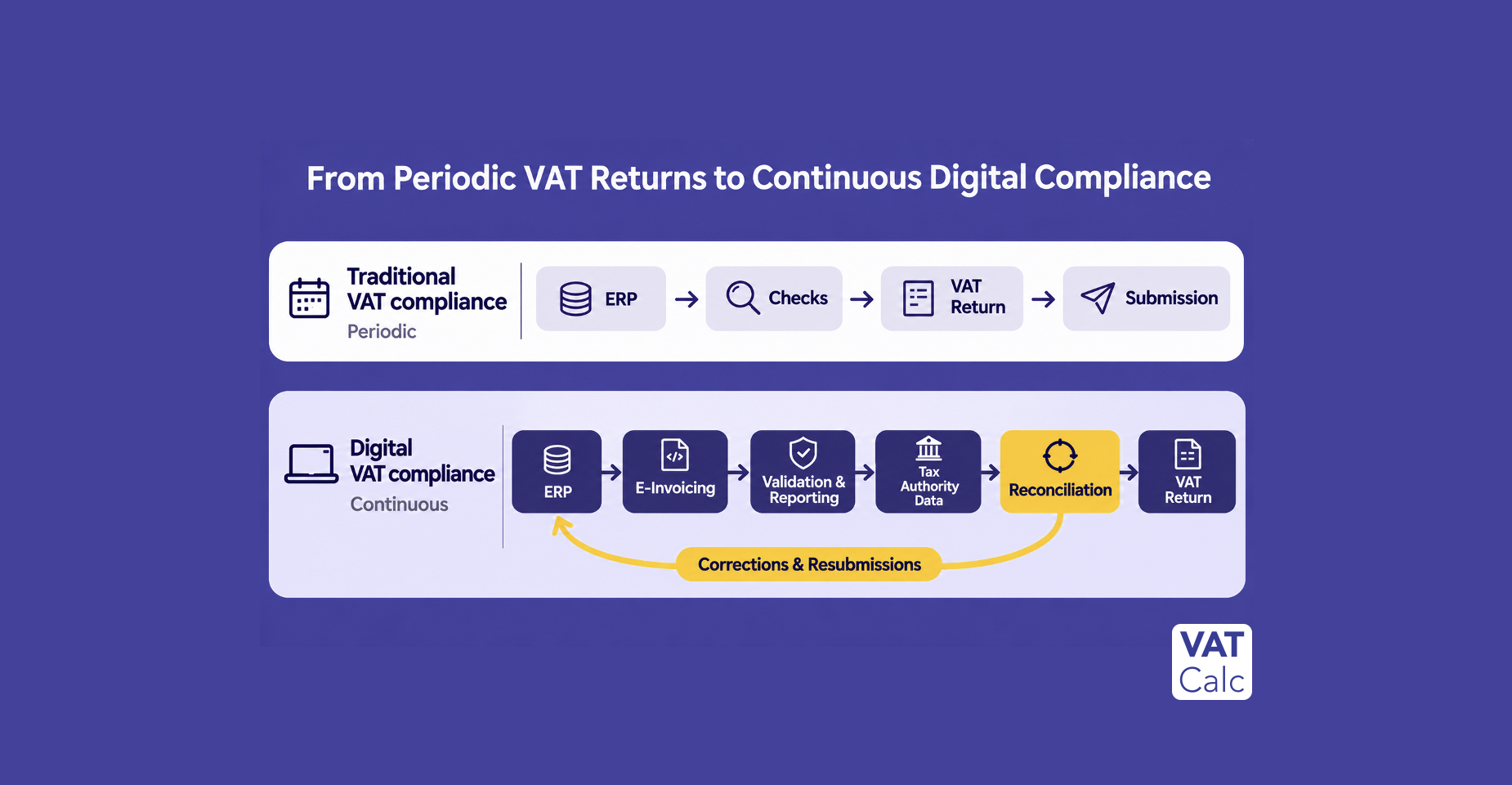
Traditional VAT compliance was largely periodic:
ERP → checks → VAT return → submission
Digital compliance is becoming continuous:
ERP → e-invoice → validation/reporting → government data → reconciliation → VAT return
And e-invoicing is rarely the only channel. Businesses may simultaneously manage e-invoice networks, government portals, real-time reporting, SAF-T and other national submissions.
When something goes wrong, correcting the VAT return may no longer be enough. Invoice data, reporting records and accounting entries may also need correcting, potentially across several systems.
Meanwhile, ViDA does not immediately eliminate national differences. Its cross-border digital reporting requirements start in July 2030, while existing domestic systems have until 2035 to align. National extensions and additional requirements risk preserving much of today’s fragmentation.
Has VAT compliance actually become simpler?
E-invoicing undoubtedly offers opportunities to automate accounts payable and receivable processes. But the implications for VAT teams are rather different.
Tax authorities are automating the collection and processing of VAT data without necessarily removing the underlying compliance work. Much of that work is moving upstream: getting transaction data right, checking tax treatment, monitoring submissions and reconciling government records against the books.
Digitalising VAT compliance doesn’t eliminate tax complexity. It exposes it.
The promised simplification may still arrive. VAT managers could perhaps be forgiven for wondering when.
Of course, if you just need a single platform for e-invoicing, e-reporting and VAT return reporting, then VATCalc has it nailed!