Slovakia’s mandatory B2B and B2G e-invoicing regime takes effect 1 January 2027, alongside supplier-side digital invoice reporting
19 Oct 2026: The tax authority publishes extensive implementation guidance, including more than 150 FAQs, manuals, validation rules and practical examples.
24 Sept: Slovakia has proposed delaying the obligation for customers to report data from received electronic invoices until 1 July 2030. This is still a proposal

Slovakia new proposed e-invoicing timeline
- 1 Jan 2026 – E-invoicing legislation entered into force, with 2026 used for system preparation and Peppol provider certification.
- 1 Jan 2027
- Mandatory structured e-invoicing starts for domestic B2B and B2G transactions by Slovak VAT-registered suppliers.
- Slovak businesses and other taxable or legal persons, including those not VAT registered, must be able to receive structured e-invoices.
- Digital invoice reporting to the Financial Administration starts alongside domestic e-invoicing.
- 1 July 2030 – E-invoicing and digital reporting extend to relevant cross-border transactions as Slovakia aligns with the EU ViDA regime.
Peppol and Slovakia’s Digital Postmen
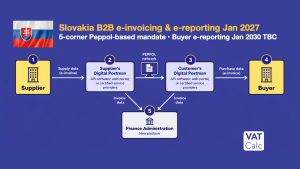
Slovakia has opted for a decentralised five-corner Peppol model, rather than a central government clearance platform. There is no requirement for the tax authority to approve an invoice before it reaches the customer.
Invoices must use a structured format compliant with EN 16931, with Peppol BIS forming the basis of the Slovak implementation.
Businesses will exchange invoices through certified delivery service providers known as Digital Postmen, accessed through accounting software, ERP integrations or standalone applications.
A business may nominate only one Digital Postman for receiving invoices under a particular tax identification number, although it can use multiple providers for sending. Suppliers do not need to know which provider their customer uses; the network routes the invoice to the correct recipient.
E-invoicing changes invoice delivery – not VAT accounting
Existing rules governing invoice creation, corrections, credit notes, statutory invoicing deadlines and document retention broadly continue.
What changes is the format and transmission. Instead of exchanging PDFs or paper documents, businesses in scope move to structured electronic invoices capable of automated processing. (Finančná správa)
Existing EDI arrangements can continue, but invoice data must be converted into a format compliant with EN 16931 where the statutory e-invoicing requirements apply. (Finančná správa)
Receiving obligation extends beyond VAT-registered businesses
The receiving obligation is particularly broad. From January 2027, Slovak legal persons and taxable persons must generally be capable of receiving structured e-invoices, even where they are not VAT registered.
The obligation to issue mandatory e-invoices is narrower and applies to VAT-registered suppliers for relevant domestic transactions. B2C transactions are outside the January 2027 mandate.
Smaller businesses do not necessarily need sophisticated ERP integrations. Low-volume businesses may use web or mobile applications supplied by their Digital Postman, potentially giving their accountant direct access.
E-reporting starts alongside e-invoicing
Slovakia is combining structured invoice exchange with digital e-reporting to the Financial Administration.
Invoice data will be transmitted electronically to the tax authority through the new infrastructure. During the transitional period to 30 June 2030, the reporting requirements are linked to invoices sent or received through the statutory delivery service.
From 1 July 2030, Slovakia moves into the EU’s harmonised ViDA digital reporting regime for relevant cross-border transactions.
Check our Slovak VAT guide. The e-invoicing regime would replace the regular electronic control statement submission.