OECD 2026: VAT reforms shift towards digital collection and real-time reporting
The OECD’s latest Tax Policy Reforms 2026 report highlights a continued transformation of VAT systems worldwide. Governments are increasingly looking beyond changes to VAT rates towards digital collection, platform liability, e-invoicing and transactional reporting.
The report reviews tax reforms introduced or announced during 2025 across 92 jurisdictions. For VAT, the OECD identifies digitalisation as one of the most significant areas of reform.
Digital VAT collection continues to spread
Countries continue to extend VAT obligations to foreign suppliers of digital services and online marketplaces. More than 116 countries have now implemented reforms based on the OECD’s international VAT standards for digital trade, with another 22 implementing or considering them.
The model is also moving beyond digital services.
The OECD says 43 countries have introduced measures to collect VAT on online sales of low-value imported goods. This typically moves VAT collection away from customs at import and towards the seller or marketplace at the point of sale. Chile extended its regime to imported goods worth up to USD 500 in October 2025, while Japan plans similar rules from April 2028.
Platform liability is developing alongside this. Chile, Saudi Arabia and Mexico have all strengthened VAT collection obligations involving digital marketplaces, while the EU’s VAT in the Digital Age (ViDA) reforms will extend deemed-supplier rules to certain short-term accommodation and passenger transport platforms from July 2028.
E-invoicing becomes part of VAT enforcement
A second major trend is the rapid adoption of electronic invoicing and Digital Continuous Transactional Reporting (DCTR).
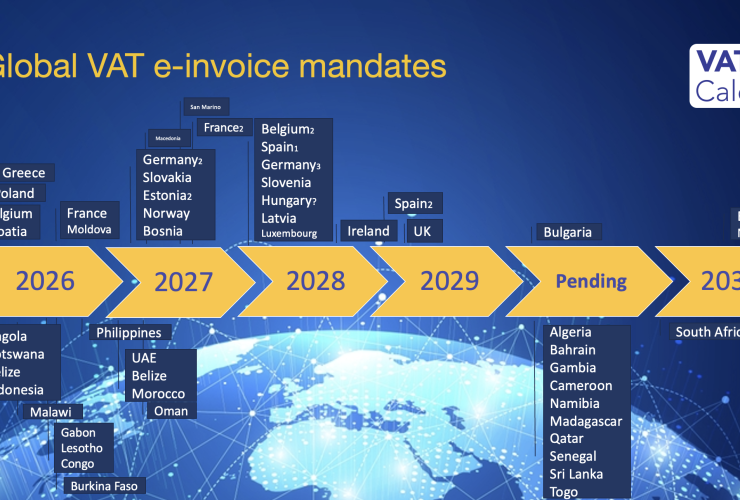
The OECD describes a global movement towards more automated and data-driven tax administration, with invoice or transaction information increasingly reported to tax authorities in or close to real time. It highlights Belgium, France, Poland, Croatia, Spain and Ireland among the European countries implementing or developing B2B e-invoicing mandates, alongside programmes in Norway, the UK, Singapore and the UAE.
The EU’s ViDA reforms reinforce this direction. Cross-border B2B Digital Reporting Requirements will apply from July 2030, supported by structured electronic invoicing. Since April 2025, EU Member States have also been able to introduce domestic mandatory e-invoicing without first obtaining a VAT derogation from the European Commission, subject to the new rules.
But the OECD also warns about fragmentation. Different national DCTR models can create additional compliance costs, legal uncertainty and interoperability problems for businesses operating across multiple jurisdictions. Its January 2026 DCTR guidance therefore focuses heavily on common approaches, interoperability and integration with businesses’ existing digital processes.
VAT rates remain a policy lever
Traditional VAT rate changes have certainly not disappeared. Twenty-seven jurisdictions reported VAT rate changes during 2025, with governments continuing to use reduced rates for food, health, utilities, housing, hospitality and cultural activities.
At the same time, fiscal pressures are pushing some rates upwards. Romania increased its standard rate from 19% to 21% and consolidated its 5% and 9% reduced rates into an 11% rate. Estonia increased its standard VAT rate to 24%.
There is also an interesting reversal in environmental VAT policy. The OECD notes that no additional countries introduced VAT rate reductions to promote environmental sustainability, while Austria, Portugal, Azerbaijan and Norway scaled back earlier VAT relief for solar equipment or electric vehicles.
From reduced rates to targeted VAT cashback?
One of the more significant longer-term developments is the growing interest in using digital data to target VAT relief at individual households.
The OECD argues that reduced VAT rates can be poorly targeted, complex and may disproportionately benefit higher-income households. It points instead to VAT refund and cashback systems used in countries including Canada, Uruguay, Colombia and Brazil.
Brazil’s new dual VAT is particularly significant. Its CBS federal VAT and IBS subnational VAT will ultimately replace five existing consumption taxes, supported by electronic invoicing and a split-payment mechanism under which VAT can be transferred automatically through the payment system. (OECD)
Brazil will also provide targeted VAT cashback to qualifying low-income households. This illustrates how e-invoicing and transaction-level data could eventually allow governments to combine broad VAT bases with more precisely targeted consumer relief.
VAT is becoming a data tax
The broader message from the OECD report is that VAT reform is increasingly about how the tax is collected, rather than simply what rate is charged.
Non-resident registration, marketplace liability, e-invoicing, real-time transaction reporting, split payments and digitally targeted refunds are gradually bringing VAT collection closer to the underlying transaction.
For multinational businesses, that changes the compliance challenge. VAT determination, invoicing and reporting can no longer be treated as separate processes completed weeks or months apart. As tax authorities obtain transaction data earlier, businesses increasingly need to determine the correct VAT treatment, produce compliant invoice data and report it through interconnected digital systems.
The OECD’s 2026 review suggests this transition is no longer confined to a handful of early adopters. It is becoming the direction of travel for VAT globally.