
Parliamentary approval for mandatory B2B e-invoicing from January 2027 with digital bookkeeping by 2030
Norway has formally approved mandatory B2B e-invoicing and digital bookkeeping requirements after Parliament adopted amendments to the Bookkeeping Act under Prop. 44 L (2025-2026).

The legislation confirms that all businesses subject to Norwegian bookkeeping obligations must issue structured electronic invoices from 1 January 2027. The reforms are intended to accelerate business digitalisation, improve tax compliance and reduce administrative costs.
The new regime will be implemented in two stages:
- 1 January 2027: Mandatory issuance of structured B2B electronic invoices.
- 1 January 2030: Mandatory receipt of electronic invoices and compulsory use of digital bookkeeping systems.
The measures apply to businesses with bookkeeping obligations in Norway. The government expects detailed technical regulations, including invoice formats and transmission requirements, to be finalised during 2026. EHF (Elektronisk Handelsformat), Norway’s existing Peppol-based standard, is expected to form the basis of the mandate.
Before the end of 2026, the tax authorities, Skattedirektoratet, will report on possible next steps such as B2C e-invoicing, e-receipts, and wider digitalisation rules.
Norway accelerates mandatory e-invoicing
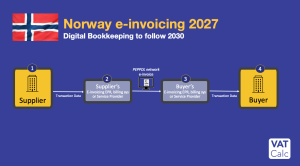
In a 16 March 2026 announcement, the government confirmed plans to mandate B2B e-invoicing from 1 January 2027, alongside a broader requirement for fully digital bookkeeping by 1 January 2030. An exemption for businesses with less than NOK 50,000 will be exempted from the obligations.
All bookkeeping-obligated entities will be required to issue structured e-invoices to each other, with systems capable of automated receipt and processing.
A bill will be considered in the Storting parliament. Furthermore, the Ministry of Finance has asked the Directorate of Taxes to follow up on the proposed legislative amendments with necessary regulatory amendments, including more detailed rules on approved invoice formats and exemptions for small businesses.
A compliance play disguised as productivity reform
The government frames the reform around efficiency, estimating NOK 10 billion in economic benefits over 20 years. Most of that comes from automation, removing manual invoice handling and reducing administrative overhead.
But for VAT and tax professionals, the subtext is more important:
- Structured e-invoicing creates clean, standardised transaction data
- Digital bookkeeping ensures end-to-end audit trails
- Reduced manual touchpoints lower both error rates and fraud risk
In other words, this is as much about tax control and transparency as it is about productivity.
The real signal: platformisation of compliance
Perhaps the most strategic element sits in what comes next. The Ministry of Finance has already asked the tax authority to explore:
- B2C e-invoicing
- Digital receipt (e-receipt) requirements
- Regulation of accounting software providers
Peppol and EHF structured e-invoices
B2G e-invoicing was implemented in 2019. Norway has adopted two standards:
- EHF (Elektronisk Handelsformat) format based on UBL (Universal Business Language).
- both the Peppol BIS 3.0 standard and the Peppol eDelivery Network – particularly for cross-border transactions. There are around 70 different Peppol BIS compliant solutions used in the private sector.
Norway has fully implemented the European standard on eInvoicing, including the EN16931 standard
The move follows neighbouring Sweden e-invoicing review which undertook a similar review two years ago – although there has been no progress since then. The EU VAT in the Digital Age reforms which will impose B2B e-invoicing on intra-community supplies from July 2030.


