Phased introduction of mandatory e-Faktura clearance from April 2027
North Macedonia has published its draft law establishing the new e-Faktura electronic invoicing and continuous transaction controls (CTC) system.
The proposal confirms that the Public Revenue Office (PRO) will operate a centralised platform for issuing, validating, receiving and storing structured electronic invoices.

The new timetable is:
- 1 October 2026 – voluntary registration and use of e-Faktura
- 1 April 2027 – mandatory for VAT-registered taxpayers
- 1 July 2027 – non-VAT registered businesses brought into scope
- 1 October 2027 – public institutions and specified state-controlled entities
- 1 January 2028 – remaining entities
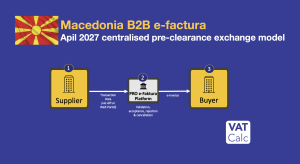
Centralised e-Faktura clearance
North Macedonia is proposing a centralised clearance model rather than simply requiring businesses to exchange structured invoices.
An electronic invoice will be issued, transmitted and received through the e-Faktura platform in a structured format capable of automatic processing.
For an invoice to become legally valid, the draft requires it to pass through the platform’s validation process. It will then receive a unique electronic invoice identifier, or EIF, and electronic timestamp.
The system will cover more than standard sales invoices. The proposed scope includes credit and debit notes, advance invoices, invoices involving foreign persons and a range of VAT and transaction-related documents.
The government’s broader tax reform programme has identified e-invoicing and e-fiscalisation as tools for improving VAT controls, reducing administrative costs and combating the informal economy.
Invoice acceptance and rejection
The draft also introduces an invoice acceptance and rejection process.
Recipients will generally have until the 10th day of the month following the transaction to accept or reject an invoice through e-Faktura. If no action is taken by the deadline, the invoice will be deemed accepted and may be used for tax and accounting purposes.
Certain supporting transaction documents, including delivery notes, will also have to be reported through the system, in some cases within two days.
This makes e-Faktura broader than a conventional electronic invoicing mandate. It will give the tax authority considerably greater visibility over transactions and their supporting documentation.
North Macedonia e-invoicing and EU ViDA
North Macedonia’s reforms come as it continues aligning its tax framework with EU rules ahead of potential accession.
However, its proposed domestic model differs from the direction taken by the EU’s VAT in the Digital Age (ViDA) reforms.
ViDA introduces structured e-invoicing and digital reporting for intra-EU transactions from July 2030, but does not require invoices to receive prior tax authority clearance before they become valid.
North Macedonia is instead proposing central platform validation and unique invoice identification. This creates an important future interoperability consideration as the country progressively aligns its VAT and digital reporting rules with the EU acquis.
For businesses operating across Europe, it is another example of why e-invoicing cannot be treated separately from VAT determination and reporting. Invoice data, VAT treatment and subsequent VAT reporting increasingly need to operate from the same underlying tax logic.
VATCalc’s single VAT platform combines tax determination, e-invoicing, digital reporting and VAT returns using centrally maintained legislative coding. This allows regulatory changes to be incorporated without businesses having to continually reconfigure separate tax, invoicing and reporting solutions.
Although North Macedonia is not yet an EU member, its alignment with EU norms remains a strategic priority. As such, the divergence in invoicing models may eventually require regulatory adjustments or interoperability measures, particularly if Macedonia progresses toward deeper economic integration with the Union.