Sweden has submitted its first legislation implementing the EU VAT in the Digital Age (ViDA) reforms
Covering Jan 2025 OSS and other preparations for major reforms

The Swedish Government submitted Proposition 2025/26:278 to Parliament on 9 June 2026. The proposal amends Sweden’s VAT Act (Mervärdesskattelagen) as the first stage of its implementation of the EU’s VAT in the Digital Age (ViDA) reforms.
This is the beginning of Sweden’s phased implementation of ViDA rather than legislation covering the entire package.
OSS schemes extended and clarified
Sweden will make several changes to the special VAT schemes covering cross-border transactions — the non-Union OSS, Union OSS and Import OSS.
For the non-Union OSS, the current requirement that the non-taxable customer must be established, resident or normally resident within the EU is removed. A non-EU supplier may therefore use the scheme for services taxable within the EU even where the customer is resident outside the EU.
Sweden is also extending the Union OSS temporarily to certain supplies of gas, electricity, heating and cooling through networks or systems where the supplier is not established in the Member State in which VAT is due. This provision applies until 30 June 2028, when the next major stage of ViDA takes effect.
The legislation also clarifies the treatment of input VAT and refund claims for businesses using the Union, non-Union and Import OSS schemes.
New tax-point rules for OSS transactions
A particularly important change concerns the VAT tax point — the point at which VAT becomes chargeable and must be reported.
New sections 22:32a–32d of the Swedish VAT Act will provide specific rules for transactions reported through the Union and non-Union OSS schemes.
As a general rule, the chargeable event occurs when the goods are supplied or the services performed. Where an advance payment is received, however, the chargeable event occurs when the payment is received.
Sweden is separating these transactions from some of its normal domestic rules on when output VAT becomes reportable. As a result, the government acknowledges that some businesses may have to report VAT in a different VAT period from that which would apply under the ordinary Swedish VAT accounting rules.
Platforms: payment can determine the VAT reporting period
There is also an important amendment for online marketplaces and other electronic interfaces treated as deemed suppliers.
Where a platform is deemed to have bought and resold goods under the VAT rules, the output VAT will be reported for the period in which payment is accepted. This applies both to the deemed supply by the underlying seller to the platform and the platform’s subsequent deemed supply.
Sweden is also widening the wording of its deemed-supplier provision. It will cover qualifying supplies by non-EU sellers not only to non-taxable persons, but also to certain taxable persons and non-taxable legal persons whose intra-EU acquisitions are not subject to VAT.
The government describes this largely as a clarification of existing practice, although Swedish business organisations raised concerns that it could increase the responsibilities and administrative burden of platforms.
€10,000 distance-selling threshold clarified
The legislation also tightens the Swedish rules implementing the EU €10,000 threshold for intra-EU distance sales and certain digital services.
For distance sales of goods, the simplification applies only where the goods are dispatched from the Member State in which the supplier is established.
There is also an important interaction with OSS: once a business registers for the Union OSS, it is treated as having opted to apply the normal place-of-supply rules rather than the €10,000 simplification. Sweden is putting this interpretation expressly into its VAT legislation.
IOSS and VAT refunds
The legislation confirms that businesses covered by Sweden’s small-business VAT scheme cannot use the Import OSS (IOSS).
There are also changes to the input VAT refund rules for businesses using the special schemes. In particular, the rules distinguish more clearly between EU-established and non-EU businesses using Union OSS.
Sweden has chosen not to use a new ViDA option allowing Member States to require a tax representative as a condition for certain VAT refunds.
This is only Sweden’s first ViDA stage
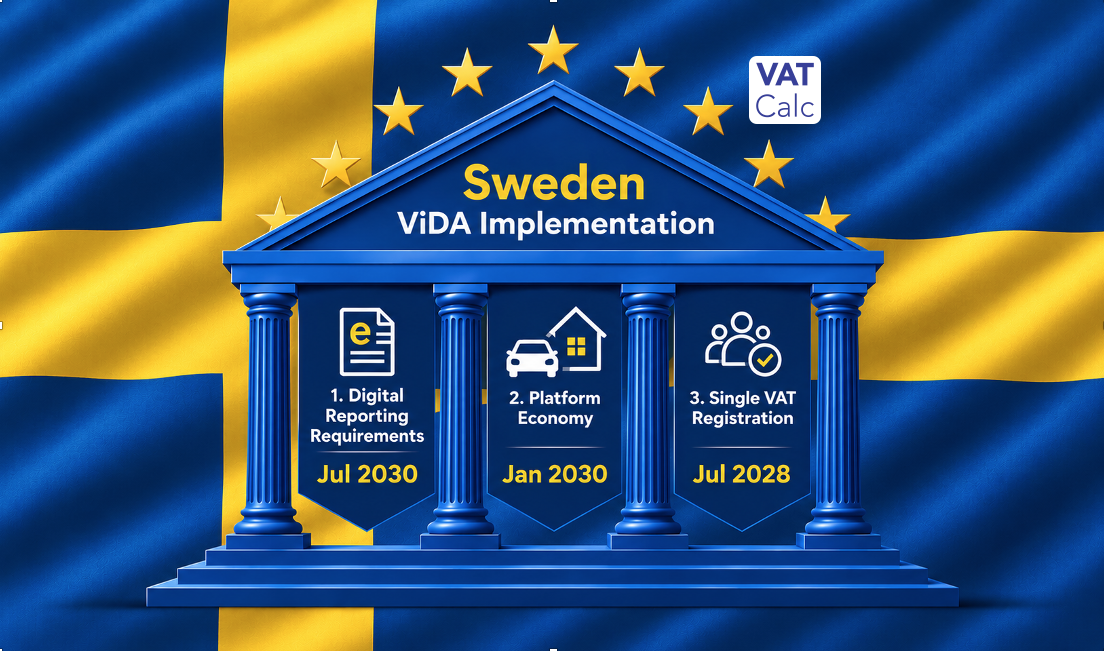
Sweden identifies five implementation stages in the EU legislation. The changes applying from 1 July 2028, 1 July 2029 and 1 July 2030 contain the major elements of the package and will require further Swedish legislation.
These include the much larger reforms to 2028 Single VAT Registration, 2028-30 Platform Economy and ultimately the ViDA cross-border e-invoicing and Digital Reporting Requirements from July 2030.
See more in our Sweden VAT Country guide.
EU member states ViDA implementation tracker
| Country (click for details) | Status | Latest | |
| 1 | Austria | 🟠 Draft legislation | Public consultation underway |
| 2 | Belgium | 🟠 Bill approved by Parliament | OSS, distance sales, electronic interfaces and related changes |
| 3 | Bulgaria | ⚪ Awaiting legislation | - |
| 4 | Croatia | 🟠 Draft / consultation | Draft partial transposition for January 2027 |
| 5 | Cyprus | ⚪ Awaiting legislation | - |
| 6 | Czechia | 🟠 Bill in Parliament | OSS changes from January 2027 |
| 7 | Denmark | ⚪ Legislative timetable set | - |
| 8 | Estonia | 🟠 Bill before Parliament | Bill 992 SE: OSS and related changes from January 2027 |
| 9 | Finland | 🟢 Adopted | |
| 10 | France | ⚪ Awaiting legislation | ViDA measures notified, but first-stage position needs separating from domestic e-invoicing reforms |
| 11 | Germany | 🟠 Bill before Parliament | - |
| 12 | Greece | ⚪ Awaiting legislation | - |
| 13 | Hungary | ⚪ Awaiting legislation | - |
| 14 | Ireland | ⚪ Awaiting legislation | - |
| 15 | Italy | 🟠 Draft legislation | Draft legislative decree – parliamentary scrutiny completed |
| 16 | Latvia | ⚪ Awaiting legislation | - |
| 17 | Lithuania | 🟢 Adopted | Law XV-1036 implements initial ViDA changes from January 2027 |
| 18 | Luxembourg | 🟠 Bill before Parliament | Bill 8812 transposes Article 2 from January 2027 |
| 19 | Malta | 🟢 Adopted | Act III of 2026 implements Article 2 from January 2027 |
| 20 | Netherlands | 🟢 Adopted | Implementation Act published October 2026; January 2027 commencement |
| 21 | Poland | 🟠 Parliamentary legislation | Bill 3074 passed Sejm; January 2027 provisions |
| 22 | Portugal | ⚪ Awaiting legislation | - |
| 23 | Romania | ⚪ Awaiting legislation | - |
| 24 | Slovakia | 🟠 Draft legislation | ViDA transposition combined with January 2027 domestic e-invoicing reforms |
| 25 | Slovenia | 🟠 Draft legislation | Partially transpose ViDA changes applying from 1 January 2027 |
| 26 | Spain | 🟠 Government legislation | Partial ViDA transposition underway in Parliament |
| 27 | Sweden | 🟠 Bill in Parliament | 2027 reforms in Parliament |