AEAT reveals SPFE technical model, private-platform reporting, payment statuses & Oct 2026 testing target
10 Sept 2026: Spain’s Tax Agency, AEAT, gives details on B2B electronic invoicing to operate from 2027, including the role of private platforms, invoice e-reporting and payment-status reporting. But set to miss 1 Oct 2027 launch target by minor period
31 July: Senators call for consolidation of e-invoicing with existing SII real-time reporting and VERI-FACTU certified software obligations

B2B e-invoicing & e-reporting with hybrid choice: five-corner private networks; or option to use free AEAT platform
At a technical seminar on 10 September 2026, AEAT presented the latest draft of the Ministerial Order governing its public electronic invoicing solution, Solución Pública de Facturación Electrónica (SPFE).
The Order remains in draft and therefore the implementation dates are not yet legally fixed. However, AEAT continues to work towards the Order taking effect on 1 October 2026 – although this is now a challenging date.
If achieved, mandatory B2B e-invoicing would start in two phases:
- 1 October 2027 – businesses with annual turnover above €8 million.
- 1 October 2028 – all other businesses and professionals within scope.
The statutory timetable is 12 and 24 months respectively from the Ministerial Order entering into force.
AEAT is also targeting October 2026 for testing, although testing will not start before publication of the final Order.
Spain confirms decentralised e-invoicing model
One of the most important clarifications is that Spain is not adopting a conventional tax-authority invoice clearance model.
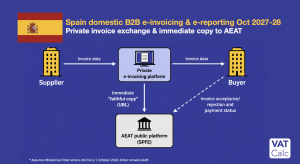
Businesses will be able to continue exchanging invoices through certified private e-invoicing platforms:
Supplier → private platform → customer
However, where a private platform is used, a faithful electronic copy must be transmitted simultaneously to AEAT’s SPFE in UBL format.
Alternatively, businesses may use the free SPFE directly to issue and receive electronic invoices.
The result is a hybrid architecture. Commercial invoice exchange can remain decentralised across private platforms, while AEAT maintains a central repository of invoice and payment information.
Private platforms must also support interoperability with other platforms when requested by their customers. The Spanish regulations recognise several invoice formats for private exchange, including Facturae, EDIFACT and Peppol BIS, while UBL is the reference syntax for SPFE.
No universal AEAT invoice clearance
Importantly for businesses preparing their systems, the AEAT presentation does not introduce a general requirement for invoices to receive prior tax-authority approval before being issued to customers.
SPFE will perform validations on files submitted to the public system before admitting them. But this should not be confused with an Italy-style clearance process in which tax-authority acceptance becomes part of the invoice issuance process.
Where businesses exchange invoices through private platforms, the commercial invoice can therefore continue through the private network while its faithful copy is reported to AEAT.
AEAT will track invoice payment via e-reporting
Spain’s regime also goes beyond simply collecting invoice data.
Customers will be required to communicate full payment of invoices, including relevant payment and due dates, to SPFE. They must also communicate invoice acceptance or commercial rejection where applicable.
AEAT’s latest technical presentation provides further implementation detail.
SPFE currently has no partial-payment message. Supplier reporting of collection or non-payment is optional, while certain invoices paid at the point of issue may not require a separate buyer payment report.
Payment dates reported by suppliers and customers may also legitimately differ, for example where invoice financing means the supplier receives funds before the customer’s actual settlement date.
The payment reporting requirements form part of the wider objective of Spain’s e-invoicing reforms: improving visibility over commercial payment periods, as well as digitalising invoicing.
AEAT invoice locator is not an authorisation code
AEAT will assign invoices held within SPFE a retrieval locator, allowing the invoice to be subsequently found and downloaded.
But this does not replace the invoice’s underlying identity.
The invoice continues to be identified principally through information including the invoice series and number, issue date and supplier NIF.
This reinforces the distinction between Spain’s model and tax clearance systems where a tax authority generates a unique authorisation identifier before an invoice becomes valid.
Corrections, rejections and outages
AEAT also provided further practical guidance on handling exceptions.
A rejection of the copy submitted to AEAT does not necessarily invalidate the original commercial invoice. Where the original invoice itself is correct but the AEAT copy was generated incorrectly, the reporting error can be corrected separately.
Businesses and software providers will also need to accommodate revised fields for corrective invoices, including correction type and method, as well as additional categories covering excise duties and special VAT regimes.
Corrective invoices are not simply edited after issuance. Cancellation and reissuance procedures apply.
AEAT has also outlined a contingency procedure for technical outages. Where an AEAT-side outage lasts more than 24 hours, affected invoices or copies may be submitted within four business days following restoration of the service.
SPFE is not an invoice archive
Businesses should not regard the new public platform as a substitute for their own statutory invoice storage.
Although SPFE will provide searches, downloads and invoice-status information, AEAT indicated that it is not intended to act as the taxpayer’s invoice storage or backup system.
Businesses will therefore remain responsible for maintaining their own invoice archives.
March 2026: Council of Ministers approval
The Council of Ministers approved on 24 March 2026 the Royal Decree mandating e-invoicing. The draft order has since been published with technical details of the regime, and AEAT issued May technical guidance, on a choice of hybrid 5-corner private network or direct state platforms for the exchange of structured e-invoice. There is also a 4-day e-reporting obligation (including payments info). But to meet the 1 October 2027 launch, the order must be confirmed by 1 October 2026.
AEAT schedules technical briefing for 10 September 2026
Spain’s Tax Agency (AEAT) has announced a technical webinar on 10 September 2026 to provide further updates on the Public Electronic Invoicing Solution (SPFE), the government platform supporting the Create and Grow (Crea y Crece) e-invoicing reforms.
The session will cover:
- progress on the draft Ministerial Order and its annexes;
- technical guidance and examples for SPFE services; and
- questions submitted by software developers and businesses.
Provisional Spanish e-invoicing launch timetable
- Oct 2026: Order enters into force
- Aug 2027: Public platform live
- Oct 2027: Mandatory for taxpayers >€8m turnover
- Oct 2028: Mandatory for all businesses
- Oct 2029: Payment status reporting extended to smaller entities
This is still a very challenging timetable by international mandate launch schedules and could easily mean a further launch slips to 2028. The new e-invoicing and e-reporting regime will initially sit alongside the existing 2017 SII real-time reporting, which is 4-day reporting of invoices in XML format, but they will likely be consolidated in the future.
What’s not clear yet is the scope for non-residents. The wording of Royal Decree 238/2026 is broad and could include the few use cases for non-resident VAT registered businesses do charge Spanish VAT on their sales (and the reverse charge is not obliged).
Spain’s draft Order on B2B e-invoicing and e-reporting provides the missing operational detail behind its forthcoming mandate, and it is notably prescriptive.
AEAT confirms hybrid public-private architecture
The new technical specifications confirm that businesses may exchange invoices via private platforms or the government’s Public Electronic Invoicing Solution (SPFE). Where private platforms are used, they must simultaneously submit a faithful copy (copia fiel) of the invoice to the SPFE. Each invoice is assigned a unique identifier based on the supplier tax number, invoice number and issue date to allow automatic duplicate detection.
The Agencia Estatal de Administración Tributaria will build and run a public e-invoicing solution that acts as:
- A mandatory universal repository for all issued and received e-invoices
- An optional issuance platform, particularly aimed at SMEs
- An interconnection hub linking private platforms
- A payment monitoring tool, tracking settlement and late payment behaviour to speed-up payments – AEAT collected data will be shared with State Observatory of Private Late Payments for resolution
Access will be free, reinforcing its role as baseline infrastructure rather than a competitor to private providers.
The role of “Faithful Copy” in dual reporting
All businesses must issue, receive and process e-invoices in B2B transactions. However, the key compliance burden sits in the “faithful copy” obligation:
- If using a private platform, businesses must simultaneously submit a structured copy of each invoice to the public system
- Recipients must report payment status (accepted, paid, rejected) within four business days, with senders optionally reporting collections
This effectively creates a continuous reporting overlay, even where private platforms are used.
EN 16931 with UBL syntax
The regime is aligned to EN 16931 semantic model using UBL 2.5 syntax (or CII; EDIFACT; Facturae Spanish XML), with several strict features:
- Unique invoice ID derived from tax ID, number, series and date
- No embedded attachments, except limited signature use
- Full validation (syntax and semantics) with acceptance/rejection responses
- End-to-end traceability, including correction and annulment process
Perhaps most significantly, Spain will use a two-layer validation model combining:
- XSD validation for structural and syntax checks
- Schematron validation for business rules
Unlike some other e-invoicing regimes, Spain will not provide a public online validation service. Instead, businesses and platforms must embed validation logic directly into their own systems before transmission.
This means implementation projects will need to focus not only on invoice generation but also on pre-submission compliance validation.
Full lifecycle reporting
AEAT wants to understand the full invoice to cash lifecycle journey to help cut down on VAT fraud. This includes customer (or their provider) reporting on:
- Acceptance
- Rejection
- Due date
- Full payment date
If the customer does not report, the invoice is deemed accepted.
Power of Attorney becomes a critical compliance requirement
The documents also highlight an important distinction regarding representation.
Invoices may be submitted either through a registered Power of Attorney (apoderamiento) or via a social collaborator arrangement.
However, invoice retrieval is more restrictive. Automated retrieval from the SPFE requires a formal Power of Attorney. Without this authorisation, automated invoice collection will not be possible.
For multinational groups, shared service centres and outsourced compliance providers, representation management is likely to become a significant project workstream during implementation.
Penalty regime
The penalty regime may rise up to €10,000 for e-invoice errors and violations.
SII and VERIFACTU run alongside
Separately, Spain certified VERIFACTU electronic invoice software obligations for smaller businesses are now likely for January 2027. And Spanish real time reporting SII would co-exist, too.
The Spanish regime will be based on the EU e-invoice Directive, around the EN 16931 structured e-invoice semantic. This in accordance with the EU VAT in the Digital Age proposals by the EU. The tax authorities reserve the right to add further data requirements, including payment details. Parties involved in e-invoice transactions may also agree to added their own additional information requirements.
Role of private e-invoicing agents
To ensure operability between all the above, private operators must have the the capacity to transform the invoice message between all the supported formats, guaranteeing the preservation of the authenticity of its origin and the integrity of
invoice content. Agents must be willing to connect to each others reporting platforms upon request. The government will approve the agents based on interoperability, digital security and continuity planning criteria.
The private operator is responsible for attaching a unique digital signature to the invoice prior to forwarding to the customer AND the tax authorities. This will contain:
- the tax identification number of the issuer;
- the number and series of the invoice; and
- the date of issue of the invoice.
Exempt transactions
The regulations exempt a number of types of transaction:
- Simplified invoices
- Where no statutory requirement to invoice
- Non-residents either customer or supplier
EU VAT in the Digital Age reforms include a channel for harmonised Digital Reporting Requirements (DRR) and Continuous Transaction Controls (CTC) by EU states. This will impose mandatory e-invoicing for EU intra-community transactions from 2028.
E-invoicing to fight VAT Gap
The proposal to extend mandatory e-invoices to all businesses and non-incorporated businesses for business-to-business transactions aims to improve the efficiency of business operations but also to help fight VAT fraud. The European Commission’s VAT Gap estimates that Spain lost €6.8 billion in expected Value Added Tax revenues.
Italy’s SdI e-invoice regime has shown remarkable success in closing its VAT Gap by almost 10% in just one year. France and Poland are to follow with 2026 being a big year for European e-invoice initiatives. The EU e-invoice consultation is well underway.
VAT Calc’s in real-time global Calculator and Auditor services produce instant and accurate tax calculations into your e-invoice, ERP, billing or e-commerce systems.