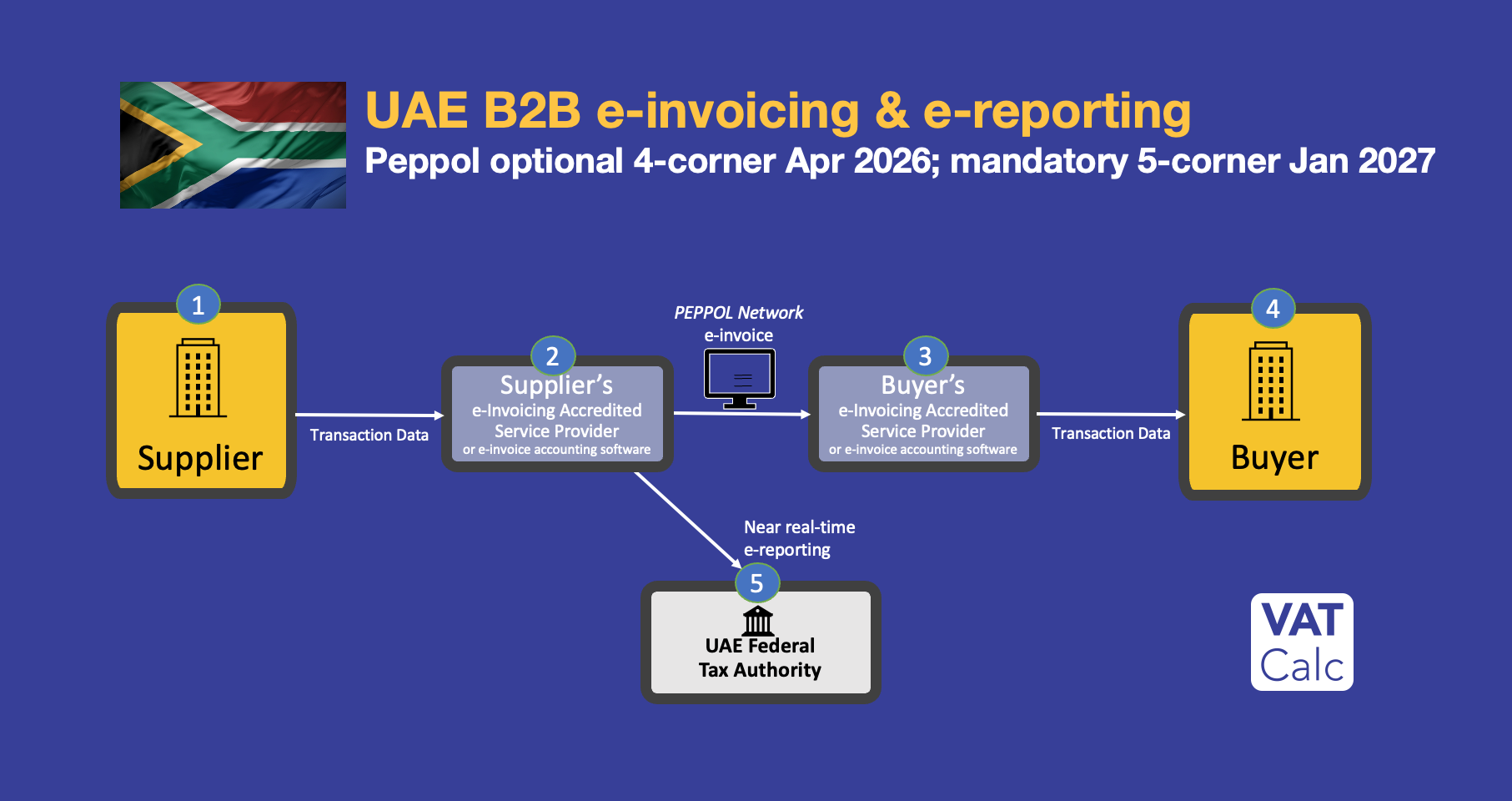
4-corner B2B e-invoicing option now live ahead of mandatory 2027 5-corner e-reporting
The UAE has formally launched its e-invoicing framework, publishing the operational 4-corner model on 21 April 2026.
This marks the first live step in the country’s move towards a mandatory Peppol-based 5-corner e-invoicing and e-reporting in 2027.

Under the design, suppliers and customers exchange invoices via their respective Accredited Service Providers (ASPs). Crucially, the invoice itself does not pass through the Federal Tax Authority yet. Instead, tax data reporting sits alongside the exchange in the broader 5-corner architecture, coming in 2027.
Peppol PINT AE-based e-invoicing and e-reporting
Taxpayers may select their e-invoicing service provider
- Businesses can now select ASPs via the EmaraTax platform and begin onboarding
- Invoice exchange (supplier to customer via ASPs) is operational ahead of reporting mandates
- A separate reporting layer to the FTA will complete the full compliance model
2026-27 launch timetable
- Optional 4-corner model live 21 April 2026
- Pilot phase: 1 July 2026
- Mandatory for large businesses (≥ AED 50m): 1 January 2027
- Mandatory for others: 1 July 2027
- Government entities: 1 October 2027
For businesses, the immediate priority is straightforward: select an ASP, contract, and test early. As seen in other jurisdictions, delays here quickly become critical path risks as mandates approach.
Mandatory fields in a PINT AE Tax eInvoice
Invoice Details
-
Invoice number
-
Invoice date
-
Invoice type code
-
Invoice currency code
-
Invoice transaction type code
-
Payment due date
-
Business process type
-
Specification Identifier
-
Payment means type code
Seller Details
-
Seller name
-
Seller electronic address
-
Seller electronic identifier
-
Seller legal registration identifier
-
Seller legal registration identifier type
-
Seller tax identifier
-
Seller tax scheme code
-
Seller address line 1
-
Seller city
-
Seller country subdivision
-
Seller country code
Buyer Details
-
Buyer name
-
Buyer electronic address
-
Buyer electronic identifier
-
Buyer tax identifier
-
Buyer tax scheme code
-
Buyer address line 1
-
Buyer city
-
Buyer country subdivision
-
Buyer country code
Document Totals
-
Sum of invoice line net amount
-
Invoice total amount without tax
-
Invoice total tax amount
-
Invoice total amount with tax
-
Amount due for payment
Tax Breakdown
-
Tax category taxable amount
-
Tax category tax amount
-
Tax category code
-
Tax category rate
Invoice Line
-
Invoice line identifier
-
Invoiced quantity
-
Unit of measure code
-
Invoice line net amount
-
Item net price
-
Item gross price
-
Item price base quantity
-
Invoiced item tax category code
-
Invoiced item tax rate
-
VAT line amount in AED
-
Invoice line amount in AED
-
Item name
-
Item description
E-billing system
E-invoicing is part of a wider initiative the Ministry of Finance describes an “e-billing system” project to develop an advanced electronic billing system and activate it at the country level. The system will also automate the procedures for filing tax returns with the tax system to facilitate filing tax returns, improve tax compliance, and reduce cases of tax evasion.
Currently, the UAE government has given legal recognition to e-invoices when agreed between transaction counter-parties.
This would follow the December 2021 Saudi Arabia e-invoicing implementation.
For regular free updates register for our global VAT and GST news.