Skip links

Eswatini e-invoicing 2028 plan

Eswatini (formerly Swaziland) issues public e-invoicing tender

The Southern African state of Eswatini is running a bidding process until 16 May for partners for the provision of fiscalisation technologies, with a formal tender in April 2025, to build a national e-invoicing regime. It’s likely that a 5-corner model e-invoicing between businesses and e-reporting to the tax authorities.

The tender is being run by the Eswatini Revenue Service (ERS). It is aiming for the project to be live by January 2028.

E-invoicing, e-reporting, fiscal devices and AI adoption

The scope includes:

  • B2B e-invoicing;
  • Fiscal data reporting ERS;
  • Fiscal devices, including POS, to integrate with ERS;
  • Use of blockchain technologies for transaction data storage and smart contracts;
  • Artificial Intelligence and machine learning to analyse tax transactions to validate compliance;
  • Mobil solutions and apps to support tax administration;
  • Compliance automation, for taxpayer reporting and timely VAT payments; and
  • Stock management and movement reporting to ERS.

Eswatini introduced VAT in 2012, which is currently charged at 15%.

Surrounding South Africa e-invoicing may go to a second consultation on its potential e-invoicing regime.

5-corner, Peppol e-invoicing model probable
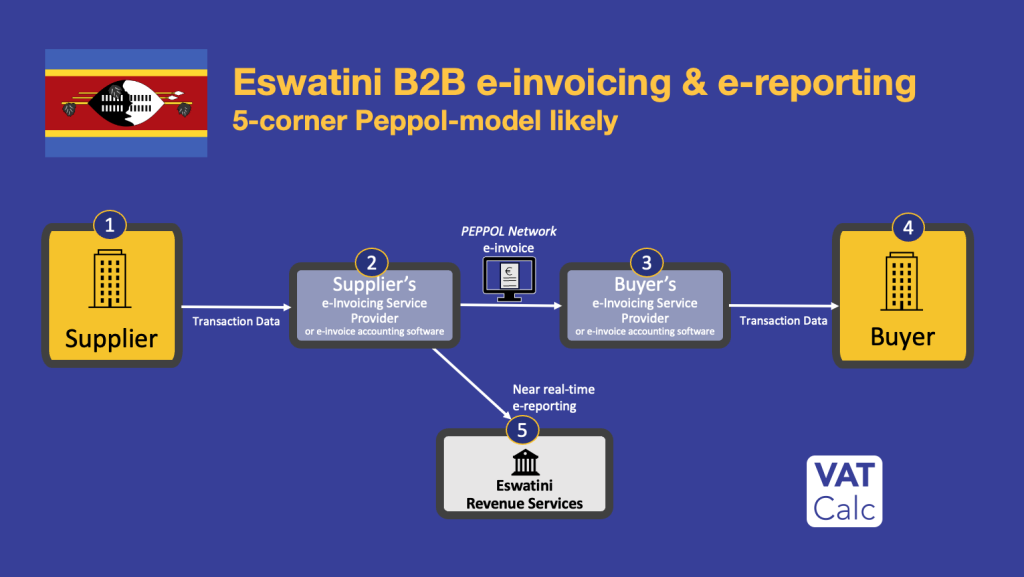
A 5-corner electronic invoice model involves five key parties: the supplier, supplier’s service provider, buyer’s service provider, buyer, and the tax authority. The supplier sends an e-invoice to their service provider, which formats and validates it.

The invoice is then transmitted to the buyer’s service provider, ensuring compliance with local regulations. The tax authority may receive a copy in real time or be notified of the transaction. This model promotes interoperability, tax compliance, and audit readiness while reducing fraud. It’s widely used in regions with decentralized but controlled e-invoicing frameworks, such as PEPPOL in the EU.

Middle East & Africa e-invoicing

Country Date Comments (click for details)
Algeria 2027? CTC e-invoicing mandate
Angola Jan 2026 Implementation plans being completed
Bahrain 2026? Plans progressing for launch 2025 likely
Benin 2020
Botswana 2025-26 Plans for e-invoicing
Burkina Faso Jul 2026 Certified e-invoicing mandate
Burundi 2022 E-Tax reporting
Cameroon TBA E-invoicing proposals
Cape Verde 2020 Mandatory e-invoicing
Côte d’Ivoire 2019 E-invoicing mandated for certain supplies
Congo, Republic 2024 e-invoicing and fiscal devices mandate
Egypt Sep 2021 E-invoice B2B and B2C
Eswatini TBC E-invoicing tender issued
Ethiopia TBC E-invoicing framework adopted
Gabon Jul 2026 E-invoicing mandated for deductibility
Gambia TBC e-invoicing proposals
Ghana 2022 Phased rollout of mandatory E-VAT invoicing regime
Israel 5 May 2024 Pre-clearance to follow Chile model
Jordan Apr 2025 Pre-clearance e-invoices and pre-filled VAT returns
Kenya Aug 2021 TIMS e-invoice
Lesotho Aug 2026 B2B e-invoicing
Madagascar 2025? E-invoicing mandate
Mauritania Oct 2023 Launch of e-invoices
Mauritius May 2024 Mandatory e-invoicing
Malawi May 2026 E-billing introduction
Morocco 2026 B2B mandate proposal
Namibia TBC E-invoicing proposals
Niger 2021 Mandatory electronic invoices for all taxpayers
Nigeria Nov 2025 B2B e-invoicing & B2C e-reporting
Oman 2026 Launch B2B Peppol e-invoicing
Qatar TBC E-invoicing draft law
Rwanda 2021 Mandatory e-invoicing for all taxpayers
Saudi Arabia Dec 2021 Pre-clearance e-invoicing
Senegal TBC Mandatory e-invoicing proposal
Seychelles TBC e-invoicing plans progress
South Africa 2030 E-invoicing, digital reporting and pre-filled returns consultation
Tanzania 2022 VFD pre-clearance e-invoicing
Togo TBC Certified e-invoicing announced
Tunisia Jul 2025 B2B and B2C e-invoices
UAE Jan 2027 E-invoice regime
Uganda Jun 2022 Pre-clearance e-invoice and fiscal cash registers
Zambia Jul 2024 E-invoicing introduction

Newsletter

Get our latest news right in your mailbox

Subscribe

* indicates required