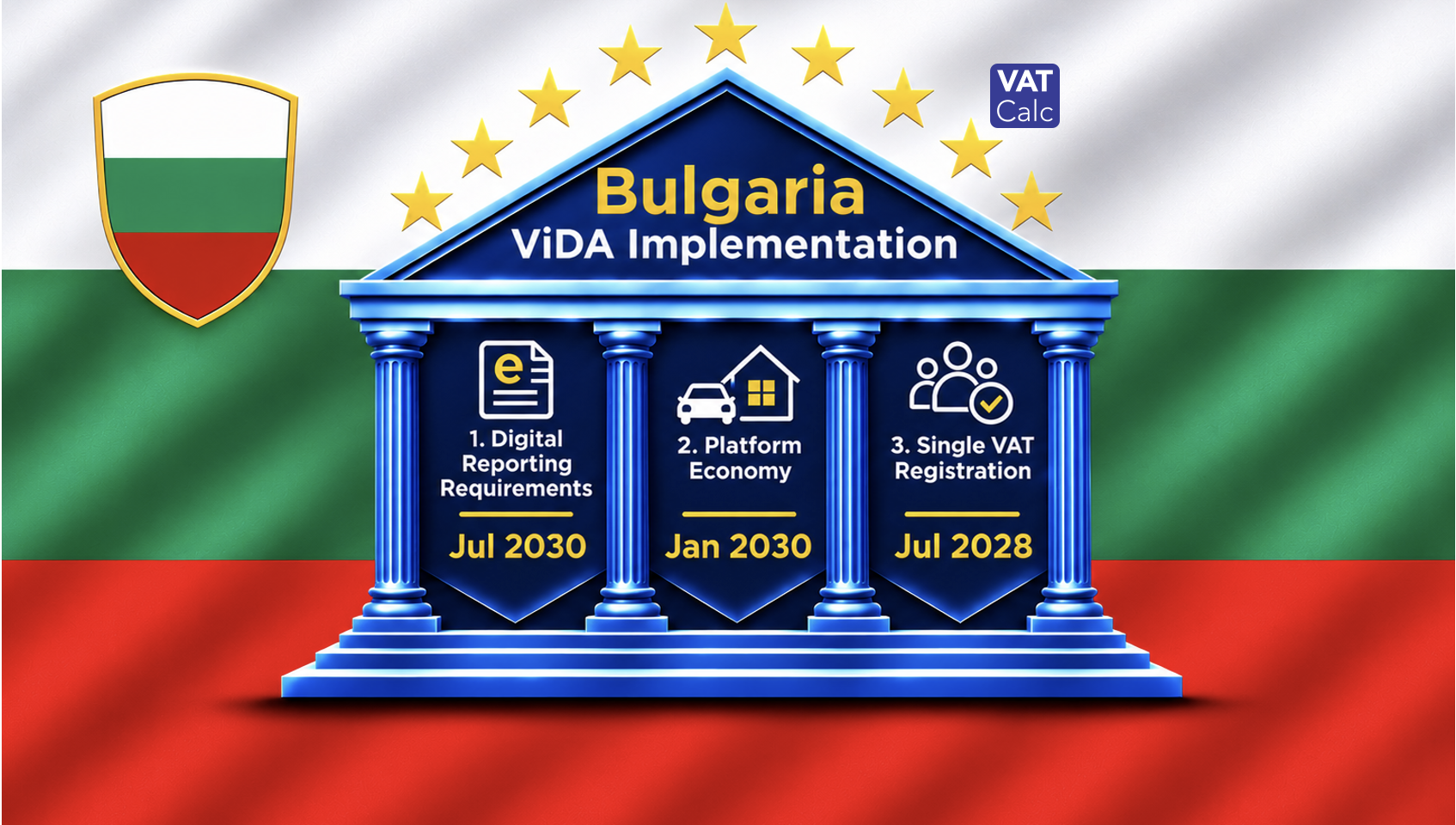

The EU ViDA proposals cover the Single VAT Registration (SVR) pillar, digital platform deemed-supplier rules, reverse charge and the eventual abolition of call-off stock arrangements.
The draft amendments were submitted to the Bulgarian National Assembly on 5 November 2026. They also introduce several domestic VAT administration changes, with implementation phased between 2027 and 2029.
You may follow all 27 EU country ViDA implementations in our tracker.
Bulgaria ViDA reforms from January 2027
The proposed amendments focus initially on expanding the One Stop Shop (OSS) arrangements and extending deemed-supplier provisions for electronic interfaces.
Single VAT Registration (SVR)
Bulgaria proposes to extend the Union OSS scheme to additional transactions, including:
- Certain domestic supplies of goods.
- Intra-EU transfers of own goods.
- Specified cross-border supplies of gas, electricity, heating and cooling.
These measures form part of ViDA’s SVR reforms, designed to reduce the requirement for businesses to maintain multiple VAT registrations across the EU.
Digital platforms and deemed suppliers
The amendments also extend deemed-supplier rules for transactions facilitated through electronic interfaces. These changes support ViDA’s platform economy reforms, under which platforms may become responsible for collecting and accounting for VAT on certain facilitated supplies.
July 2028: Reverse charge expansion
A further important proposal introduces a broader reverse-charge mechanism for supplies made by VAT-registered but non-established businesses to VAT-registered Bulgarian customers.
Under the proposed rules, the Bulgarian recipient would account for VAT rather than the non-established supplier charging Bulgarian VAT.
This represents another significant step towards ViDA’s SVR objective of reducing unnecessary foreign VAT registrations.
July 2029: Call-off stock arrangements abolished
Bulgaria also proposes the permanent abolition of its existing call-off stock arrangements from 1 July 2029, reflecting the transition towards the expanded OSS treatment of intra-EU movements of own goods.
Businesses currently relying on call-off stock simplifications will need to review their arrangements and the applicable transitional provisions.
Separate domestic e-invoicing reforms from July 2028
Bulgaria is also progressing its mandatory domestic B2B e-invoicing and real-time reporting regime, now proposed for 1 July 2028. This includes a revised decentralised invoice exchange model and pre-populated VAT returns.
See our separate analysis: Bulgaria delays mandatory B2B e-invoicing to July 2028.
Bulgaria begins its ViDA legislative journey
The proposals represent Bulgaria’s first substantial legislative steps towards implementing ViDA, ahead of the EU’s broader 2028 and 2030 deadlines.
For businesses, the immediate priorities are understanding the expanded OSS and deemed-supplier rules, reviewing reverse-charge obligations and preparing for the eventual withdrawal of call-off stock simplifications.
VATCalc’s legislative tax engine tracks national variations in EU VAT rules, including reverse-charge obligations, deemed-supplier treatment and cross-border transaction determination. These rules feed into VAT calculations and reporting, helping businesses manage the increasingly complex transition to ViDA.
The amendments remain proposals and are subject to parliamentary approval.
EU member states ViDA implementation tracker
| Country (click for details) | Status | Latest | |
| 1 | Austria | 🟠 Draft legislation | Public consultation underway |
| 2 | Belgium | 🟠 Bill approved by Parliament | OSS, distance sales, electronic interfaces and related changes |
| 3 | Bulgaria | 🟠 Bill being considered by Parliament | Initial 2027 to 2029 reforms presented |
| 4 | Croatia | 🟠 Bill being considered by Parliament | Draft partial transposition for January 2027 |
| 5 | Cyprus | ⚪ Awaiting legislation | - |
| 6 | Czechia | 🟠 Bill in Parliament | OSS changes from January 2027 |
| 7 | Denmark | ⚪ Legislative timetable set | - |
| 8 | Estonia | 🟠 Bill before Parliament | Bill 992 SE: OSS and related changes from January 2027 |
| 9 | Finland | 🟢 Adopted | |
| 10 | France | ⚪ Awaiting legislation | 2028 ViDA measures notified, but first-stage position needs separating from domestic e-invoicing reforms |
| 11 | Germany | 🟠 Bill before Parliament | - |
| 12 | Greece | ⚪ Awaiting legislation | - |
| 13 | Hungary | 🟠 Bill before Parliament | Initial 2027 changes only |
| 14 | Ireland | ⚪ Awaiting legislation | - |
| 15 | Italy | 🟠 Draft legislation | Draft legislative decree – parliamentary scrutiny completed |
| 16 | Latvia | 🟠 Bill before Parliament | Initial 2027 changes only |
| 17 | Lithuania | 🟢 Adopted | Law XV-1036 implements initial ViDA changes from January 2027 |
| 18 | Luxembourg | 🟠 Bill before Parliament | Bill 8812 transposes Article 2 from January 2027 |
| 19 | Malta | 🟢 Adopted | Act III of 2026 implements Article 2 from January 2027 |
| 20 | Netherlands | 🟢 Adopted | Implementation Act published October 2026; January 2027 commencement |
| 21 | Poland | 🟢 Adopted | First, 2027 changes signed into law |
| 22 | Portugal | ⚪ Awaiting legislation | - |
| 23 | Romania | ⚪ Awaiting legislation | - |
| 24 | Slovakia | 🟠 Draft legislation | ViDA transposition combined with January 2027 domestic e-invoicing reforms |
| 25 | Slovenia | 🟠 Draft legislation | Partially transpose ViDA changes applying from 1 January 2027 |
| 26 | Spain | 🟠 Government legislation | Partial ViDA transposition underway in Parliament |
| 27 | Sweden | 🟠 Bill in Parliament | 2027 reforms in Parliament |