Spain publishes initial technical architecture for mandatory B2B e-invoicing
Spain’s tax authority (AEAT) has published the first detailed technical and operational specifications for its upcoming mandatory B2B e-invoicing regime, providing businesses and service providers with the clearest picture yet of how compliance will work in practice. The timetable remains:
- 1 Oct 2027: large businesses above €8m turnover
- 1 Oct 2028: all other taxpayers

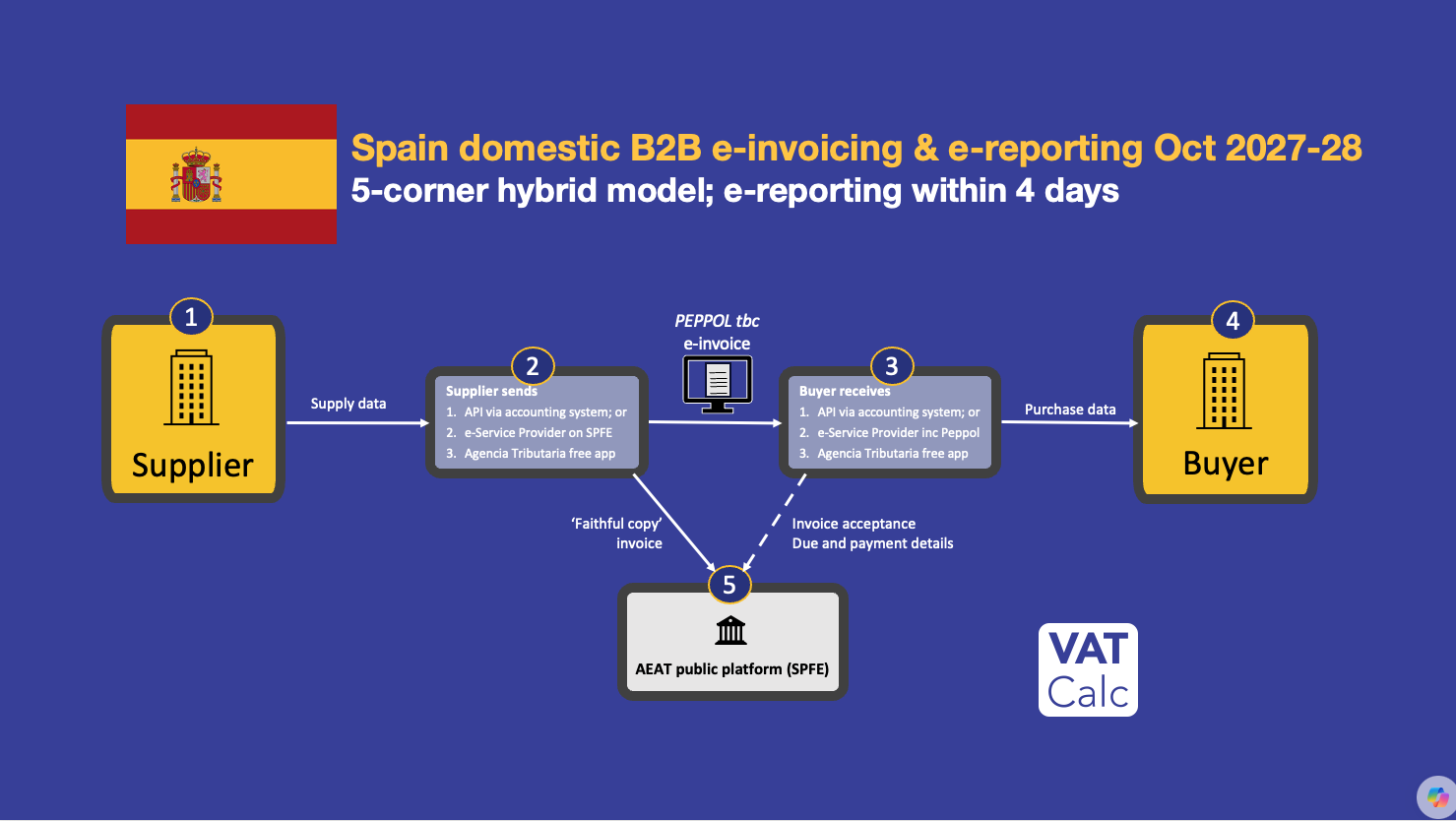
B2B e-invoicing & e-reporting with hybrid choice: five-corner private networks; or option to use free AEAT platform
The publication of two key documents in May moves Spain’s e-invoicing programme from legislative planning into implementation design.
Note: this initiative is separate from the existing SII and Veri-Factu regimes already in operation in Spain.
UBL, EN 16931 and full invoice lifecycle reporting
- Spain has confirmed UBL 2.5 as the mandatory invoice syntax, aligned with EN 16931, the EU standard.
- Private platforms remain central to the model but must deposit a faithful copy of invoices into the government platform.
- Businesses will need to manage invoice lifecycle reporting, validation controls and representation requirements well before the October 2027 mandate.
Spain confirms hybrid public-private e-invoicing model
The documents provide important confirmation that Spain will operate a hybrid model combining private service providers with the government’s Public Electronic Invoicing Solution (Solución Pública de Facturación Electrónica – SPFE).
Where businesses exchange invoices through private platforms rather than directly via the SPFE, the platform must simultaneously submit a “faithful copy” (copia fiel) of the invoice to the public platform. This copy must be specifically identified using a CopyIndicator flag.
This approach allows Spain to maintain a central government repository while preserving a role for private operators.
Each invoice will also carry a unique identification code based on the supplier’s tax number (NIF), invoice series and number, and issue date. This enables automatic duplicate detection across the system.
Mandatory invoice status reporting
The specifications provide further detail on Spain’s planned invoice lifecycle reporting obligations.
Mandatory status events include:
- Acceptance or rejection of the invoice
- Due date information
- Full payment date
Notably, silence from the recipient is treated as acceptance, reducing the need for explicit confirmations in many cases.
These status requirements will create new reporting obligations extending beyond simple invoice transmission and will require businesses to maintain accurate invoice tracking processes.
New obligations for platforms and intermediaries
The documents also clarify the role of service providers and intermediaries.
Platforms must:
- Aggregate invoice traffic for their clients
- Hold formal Powers of Attorney (apoderamiento)
- Automatically retrieve invoices on behalf of customers
This effectively rules out simple pass-through or messaging-only models that do not actively manage invoice exchanges and retrieval.
For many providers, obtaining and maintaining customer authorisations may become as important as the technical integration itself.
UBL 2.5 confirmed as the technical standard
On the technical side, AEAT has now confirmed several key design decisions.
The Spanish system will require:
- UBL 2.5 syntax
- Alignment with EN 16931:2026
- Certificate-based authentication
- Synchronous web service connections
Perhaps most significantly, Spain will use a two-layer validation model combining:
- XSD validation for structural and syntax checks
- Schematron validation for business rules
Unlike some other e-invoicing regimes, Spain will not provide a public online validation service. Instead, businesses and platforms must embed validation logic directly into their own systems before transmission.
This means implementation projects will need to focus not only on invoice generation but also on pre-submission compliance validation.
Power of Attorney becomes a critical compliance requirement
The documents also highlight an important distinction regarding representation.
Invoices may be submitted either through a registered Power of Attorney (apoderamiento) or via a social collaborator arrangement.
However, invoice retrieval is more restrictive. Automated retrieval from the SPFE requires a formal Power of Attorney. Without this authorisation, automated invoice collection will not be possible.
For multinational groups, shared service centres and outsourced compliance providers, representation management is likely to become a significant project workstream during implementation.
Upcoming legislation timetable starting October 2026
The next major milestone will be publication of the Ministerial Order in Spain’s Official State Gazette (BOE), expected on 1 October 2026.
Following publication, businesses can expect:
- Opening of the government sandbox environment
- Developer portal documentation
- Publication of XSD schemas
- Publication of Schematron business rules
- WSDL technical specifications
- Sample message libraries
The first compliance deadline remains expected in October 2027 for large businesses, followed by smaller taxpayers in October 2028.
VAT Calc’s in real-time global Calculator and Auditor services produce instant and accurate tax calculations into your e-invoice, ERP, billing or e-commerce systems.