

ZATCA opens 25th wave of e-invoicing Feb 2027
Update 24 July 2026: The Saudi Arabian Zakat, Tax and Customs Authority (ZATCA) has confirmed the 27th wave of taxpayers to register for VAT must do so by 1 February 2027. This covers businesses with turnover of over SAR 187,500
19 May ZATCA issued the third version of the country’s e-invoicing controls and technical specifications.

FATOORAH Jun 2026 24th wave of mandatory B2B e-invoicing
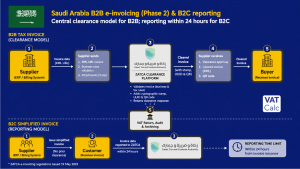
ZATCA confirms the twenty forth wave of implementation of taxpayers to join the Phase 2 (Integration Phase) of mandatory e-invoicing. These are taxpayers with an annual income between SAR 375,000 million and SAR 750,000 in either 2022 or 2023. They will be obliged to comply with the national FATOORAH regime – although ZATCA will inform them of the exact date. Phase 1 was enacted in December 2021.
The confirmed waves so far include:
25th wave Feb 2027 – taxpayers annual income between SAR 0.35 million and SAR 187,500
24th wave Jun 2026 – taxpayers annual income between SAR 750,000 and SAR 350,000
23rd wave Mar 2026 – taxpayers annual income between SAR 0.75 million and SAR 1 million
22nd wave Jan 2026 – taxpayers annual income between SAR 1 million and SAR 1.25 million
This will require businesses to:
- B2B XML invoices should be sent to ZATCA for prior clearance (Continuous Transaction Controls CTC) .
- B2C invoices will instead be reported in near-live format, within 24 hours of booking. Paper invoices for customers is still permitted, although e-invoices can be offered. In either case, a QR Code is required.
The latest guidance for businesses above the threshold covers:
- Control requirements, business rules for validation of the xml invoices
- Technical specifications of e-invoices, certain data fields between mandatory, conditional or optional
- Procedural rules, including VAT Group number treatment and inclusion of Fields for the Purchase Order and Contract Identification Numbers
This follows examples in Europe (e.g. Italy) and from around the world whereby tax authorities seek to gain transactional-level details of tax liabilities to help detect and prevent evasion. Check VAT Calc’s global live VAT invoice transaction and e-invoice reporting tracker to see where else real-time submissions of invoices is being implemented.
Phase 1, Issue and Storage (Generation), 4 December 2021
This covered the obligations to issue, receive and store sales and purchase e-invoices in a secure manner from e-invoicing system. The scope will include the following transactions:
- Domestic;
- Zero rated; and
- Exports
The following transactions are excluded:
- Exempt supplies
- Import of goods; and
- Supplies subject to reverse charge mechanism
Invoices are required to contain a QR Code for B2C invoices at least. B2B will remain optional. invoices must include the mandatory fields and must be issued from an electronic system meeting ZATCA’s requirements. In addition, electronic copies of all issued invoices must be stored by the taxpayer.
ZATCA laid out the basic requirements for the Phase 1, Issue and Storage, stage. This covers the:
- Controls, requirements, technical specifications, and procedural rules to implement the provisions of the e-invoicing regulations
- e-invoice XML implementation requirements;
- security structures; and
- QR Code invoice requirement
E-invoicing systems may include: Online cash registers, virtual cash registers on tablets, e-invoicing software installed on a computer, e-invoicing software in- stalled on phone or tablet and cloud- based solutions are examples of e-invoicing solutions.
VAT Calc’s in real-time global Calculator and Auditor services produce instant and accurate tax calculations into your ERP, billing, e-commerce or e-invoicing systems. This includes Saudi Arabia, other Gulf states as the follow and the rest of the world.


