SARS FAQ’s on 2030 five-corner e-invoicing, near real-time VAT reporting, ERP integration and pre-filled VAT returns
18 September 2026: South African Revenue Service (SARS) issued Frequently Asked Questions on its mandatory e-invoicing, near real-time VAT transaction reporting and ultimately pre-filled VAT returns.
Update 8 September 2026: has provided further details of its proposed Digital VAT Model This builds on the Tax Administration Laws Amendment Bill (TALAB), which was passed into law on 1 April 2026.

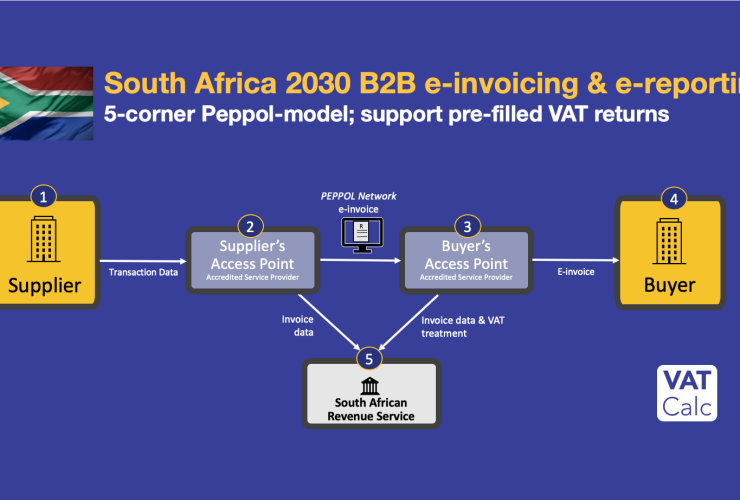
Peppol-based 5-corner real-time VAT transaction reporting
The reform remains subject to consultation, which runs to 18 October, detailed design and approvals. There are significant further issues to resolve, including the obligations of non-resident vendors.
South Africa VAT modernisation timetable
The current indicative timetable is:
2026–2027 – consultation and preparation
2027–2028 – solution development and regulations
2028–2029 – testing and readiness
2029 – pilot and voluntary participation
From 2030 – phased mandatory implementation
SARS stresses that this remains indicative and will depend on consultation, approvals and market readiness.
One Digital VAT Model
The proposed model brings together three elements:
- structured electronic invoices
- an interoperability framework
- near real-time e-reporting to SARS
SARS intends transaction data generated through ordinary business processes eventually to support VAT validation, risk analysis, pre-filled VAT returns and potentially VAT auto-assessments.
Taxpayers would still be able to review and correct information and challenge assessments.
Five-corner e-invoicing model
The new FAQs provide important clarification of the planned e-invoicing architecture.
South Africa is considering a five-corner decentralised model involving:
Supplier → Supplier Service Provider → Buyer Service Provider → Buyer
with SARS or its service provider forming the fifth corner.
Rather than requiring invoices to pass through a single central government platform, businesses would exchange structured invoices through accredited service providers operating within an interoperability framework.
This should allow existing accounting and ERP systems to connect to the network through approved providers.
Decentralised invoice clearance
Accredited service providers would also perform required validations before an electronic invoice is transmitted.
Invoices that fail the relevant checks could be rejected and returned for correction.
This amounts to a form of decentralised clearance: invoice validation takes place within the accredited network rather than every invoice necessarily being cleared centrally by SARS.
SARS has also clarified that it does not necessarily need every piece of commercial information contained on an invoice. The final VAT data requirements will be determined as the model is developed.
Near real-time VAT reporting
The e-invoicing network would provide SARS with structured transaction data on a near real-time basis.
This could enable SARS to compare the VAT treatment reported by suppliers and customers, identify inconsistencies earlier and perform automated risk checks before the VAT return is filed.
It represents a significant shift from today’s predominantly return-based controls towards continuous transaction-level VAT controls.
The same data could eventually be used to pre-populate VAT returns.
ERP integration for larger businesses
The FAQs also make the implications for larger businesses clearer.
SARS envisages ERP and accounting systems connecting to accredited service providers so that sales and purchase invoices can flow automatically through Accounts Receivable, Accounts Payable and VAT compliance processes.
The VAT return therefore becomes the end of a much broader digital transaction chain:
ERP → VAT determination → e-invoice → validation → e-reporting → VAT return
For multinational businesses, this will make consistency between tax determination, invoice data and VAT reporting increasingly important.
Phased implementation from 2030
SARS does not envisage every business becoming subject to the new requirements simultaneously.
Pilot and voluntary participation are expected first, followed by mandatory onboarding of selected sectors or taxpayer groups. Factors such as business readiness, risk and transaction volumes may influence sequencing.
Smaller businesses may therefore enter the regime later than larger VAT vendors.
Detailed thresholds, sector coverage and implementation dates have not yet been confirmed.
Towards pre-filled VAT returns
Perhaps the most significant longer-term element is what SARS intends to do with the transaction data.
Near real-time information could be used for automated validation and risk assessment, but SARS also envisages pre-filled VAT returns and potentially future VAT auto-assessments.
For compliant businesses, better transaction data could ultimately support faster processing of lower-risk VAT refunds and reduce routine verification requests.
This reflects SARS’s wider objective of embedding tax compliance into businesses’ normal systems rather than relying principally on retrospective declarations.
From e-invoicing to continuous VAT compliance
South Africa’s proposals increasingly resemble a complete digital VAT architecture rather than a standalone e-invoicing mandate.
The five-corner model provides the invoice exchange infrastructure. Near real-time reporting gives SARS transaction-level visibility. ERP integration connects those requirements directly to businesses’ underlying tax and accounting data.
And pre-filled returns potentially complete the chain.
For businesses preparing for 2030, the challenge will therefore not simply be generating a compliant electronic invoice. They will need to ensure that the VAT determination, invoice, accounting records, e-reporting and VAT return all use consistent transaction data and tax logic.
The official SARS material supports the 2030 phased start, the three-part Digital VAT Model and the longer-term move towards auto-assessment. SARS also confirms that implementation sequencing remains subject to consultation, approvals and readiness.