Jan 2027 B2B & B2G structured e-invoices and near real-time e-reporting to tax authorities
5-corner Peppol model, harmonised to EU ViDA July 2030 digital reporting
21 Aug 2026: The Finance Directorate has issued new Frequently Issued Questions for the launch of its e-invoicing mandate. This includes invoice timing, Peppol e-invoice tax coding and VAT Group guidance.
25 May 2026: Ministry of Finance proposes Jan – Mar 2027 penalty soft landing for taxpayers making best efforts to comply and removing buyer-side invoice reporting

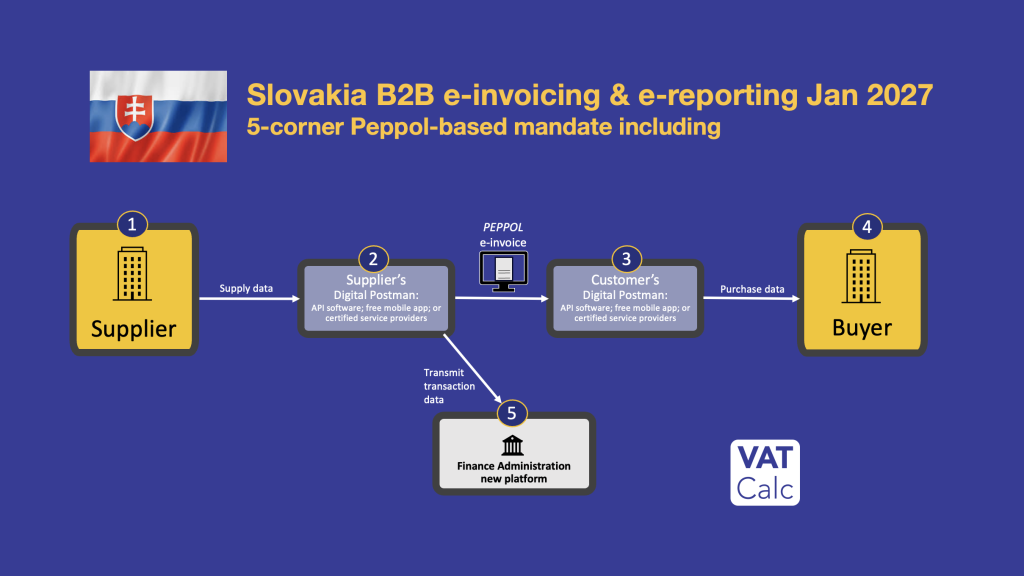
The FA is aiming for a 5-corner, decentralised e-invoicing model, use the CIUS in scope of the Peppol BIS 3 format. It will apply to resident taxpayers only for: domestic supplies; and imports – both from within the EU and external.
The e-invoicing mandate will mean withdrawing both the domestic Control Statements and the intra-community ESL’s from June 2030.
Slovakia is rolling its reporting requirements in the following stages:
- Early 2026: voluntary transition period
- Jan 2027: businesses should be able send, receive and store structured e-invoices for B2B and B2G domestic transactions only based on the EU EN16931 standard;
- Jan 2027: real-time reporting to the tax authorities of the above domestic transactions.;
- Jul 2030: ViDA-based requirement for e-invoicing and reporting of intra-community B2B transactions.
Currently, only certain B2G transactions in excess of €5,000 will be mandated to use e-invoicing via the new government IS EFA interface.
Exchange via Digital Postman
Taxpayers will be required to exchange e-invoices via approved access points, known as Digital Postmen, which may be:
- API enabled accounting software;
- Use of free mobile phone app; or
- Approved e-invoicing service providers
Invoices must be exchanged within 15 days of the tax point, as per today.
Peppol authority appointed
The Peppol authority of the Slovak Republic is the Financial Directorate of the Slovak Republic. It has transferred competences from the Peppol coordinating authority and is entrusted with supervision for the jurisdiction of the Slovak Republic.
It is responsible for:
- accreditation of Digital Postman service providers (Access Points)
- creation and management of national rules for the implementation of the Peppol standard; and
- support for the use of eInvoice in both the private and public sectors.
Update to VAT Act e-invoicing based on EU standard
The amendments to the VAT Act will introduce an obligation for payers to issue and receive invoices in the prescribed electronic format, effective from 1 January 2027. An electronic invoice will only be considered an invoice that contains the information required by the VAT Act and that is issued, sent and received in a structured electronic format that allows for its automatic and electronic processing. In order to ensure the uniformity of electronic invoices concerning payers, an obligation will be established to issue invoices in a structured format that complies with the European standard for electronic invoicing and the list of its syntaxes established by Directive 2014/55/EU of the European Parliament and of the Council of 16 April 2014 on electronic invoicing in public procurement.
With effect from 1 January 2027, an obligation will be introduced to report data from issued and received electronic invoices for domestic transactions. Invoice data will be reported electronically in a manner that is consistent with the manner established in Article 4 of the Directive, which regulates the submission of data from electronic invoices for cross-border transactions within the EU. The aim of the above changes is to digitize the entire process from the supplier’s creation to the customer’s processing of the electronic invoice, as well as the subsequent sending of data from the electronic invoice to the financial administration so that this entire process is automated with a minimum of manual intervention, resulting in a significant shortening of the processes related to the receipt of invoices and their subsequent processing (e.g. elimination of entering data from paper invoices into the system).
E-invoicing to cut tax fraud
The measure on the part of the state will contribute to the effective fight against tax fraud, has the potential to reduce tax gaps in both value added tax and corporate income tax, and improve tax collection. By making data from electronic invoices available in real time, the financial administration will be able to process input data needed to identify the fulfillment of tax obligations in a timely manner, or to set up certain control mechanisms within the framework of risk analysis to prevent fraudulent actions, with possible simultaneous adjustments to selected tax administration institutes. The above assumes a change in end-to-end services and related information systems of financial administration, as well as building capacities using new analytical tools for processing data obtained from electronic invoices.
On the part of business entities, business operations will also be simplified and the efficiency and quality of the business environment will improve. At the same time, the speed of data transfer, guarantee and credibility of communication will increase by introducing standardization in the field of electronic invoicing due to the current diversification of the environment (different levels of standards used, an environment sensitive to emerging errors, etc.).
In addition, in accordance with the aforementioned objective of the Slovak government to make the fight against tax evasion more effective, with effect from 1 January 2026, changes will be made in the area of tax registration in order to eliminate avoidance of the registration obligation, as well as in the area of deregistration, in order to prevent the re-entry of persons who have demonstrably actively and knowingly participated in fraudulent transactions into the VAT system.
Check our Slovak VAT guide. The e-invoicing regime would replace the regular electronic control statement submission.