April 2029 B2B & B2G mandate for e-invoicing exchange; e-reporting may be added
2026 Budget includes roadmap for implementation of Peppol-based B2B e-invoicing exchange; e-reporting option consultation

The UK Chancellor on 28 October 2026 published the 2027-29 roadmap for the B2B e-invoicing exchange mandate. It will be a 4-corner Peppol model without e-reporting obligations (yet!). Plus, e-invoicing for non-residents with a UK VAT number. HMRC, where possible, will use the existing VAT invoicing penalty framework for e-invoicing non-compliance.
UK e-invoicing mandate 1st April 2029 – e-reporting likely to be added
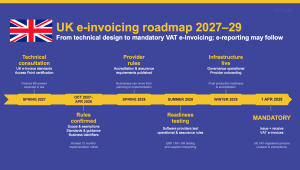
The new roadmap provides considerably more certainty:
- Peppol: confirmed as the UK’s core interoperability framework.
- Spring 2027: technical consultation on UK e-invoicing standards.
- Oct 2027–April 2028: final scope, exemptions, standards, identifiers and provider requirements are expected.
- Summer 2028: software-provider readiness testing.
- Winter 2028: infrastructure and governance arrangements operational.
- 1 April 2029:
- mandatory e-invoicing starts.
- providers operating within the UK regime are expected to have completed any required UK Peppol accreditation.
- VAT invoices: the mandate applies where UK VAT law currently requires a VAT invoice, principally taxable supplies between VAT-registered persons.
- Issue and receive: VAT-registered persons will need the capability to both send and receive compliant e-invoices.
The government says businesses will therefore receive at least 12 months’ notice of the final technical requirements.
HMRC will become the UK Peppol Authority, taking over the role currently sitting with NHS Supply Chain. HMRC will oversee UK-specific requirements, Access Point standards and interoperability governance.
Who will be caught by the UK e-invoicing mandate?
The roadmap is broader and clearer than earlier indications of a potentially phased large-business rollout.
From April 2029, UK VAT-registered persons will need to issue VAT invoices electronically when invoicing another VAT-registered person, unless an exemption applies. This includes businesses, sole traders, partnerships, charities and VAT-registered public bodies.
The government expects only narrow exemptions, including an exemption for businesses that are digitally excluded.
Non-resident businesses are in scope too
HMRC has confirmed that the e-invoicing mandate will extend to non-established taxable persons registered (NETP’s) for UK VAT.
Overseas businesses making domestic UK supplies for which a VAT invoice is required should therefore expect to issue and receive compliant e-invoices from April 2029. Detailed scope and exemptions will follow in 2027–28.
Existing EDI systems will not necessarily be enough
The roadmap also addresses businesses already exchanging invoices through EDI and other legacy networks.
HMRC recognises the substantial investment businesses have made in these systems and intends to allow them to continue. But there is an important qualification: businesses using legacy arrangements will also need to be capable of exchanging invoices through the future UK framework so that they can interoperate with other businesses.
Further guidance on the treatment of EDI is promised for autumn 2027.
For large businesses, this could become one of the more significant implementation issues. An existing electronic invoice process is not necessarily the same thing as compliance with the new UK e-invoicing standard.
Digital reporting: the bigger VAT question
The initial Peppol mandate does not itself require invoice data to be transmitted to HMRC in real time. It is essentially an invoice exchange model between suppliers and customers.
However, the government has now launched a consultation on adding digital reporting alongside mandatory e-invoicing. The consultation runs until 20 January 2027.
This raises the prospect of the UK moving from today’s Making Tax Digital model – digital records feeding periodic VAT returns – towards transaction-level reporting based on structured invoice data.
That would be a much bigger change. E-invoicing digitises the invoice. Digital reporting gives HMRC access to the underlying transaction data. Combine the two and the traditional VAT return increasingly becomes a reconciliation of data HMRC may already hold.
Could MTD for VAT become the foundation?
One question will be how far HMRC builds the reporting regime around infrastructure businesses already use.
Making Tax Digital for VAT already requires digital VAT records and API-based submission of VAT returns. Accounting software providers are therefore connected to HMRC and already sit between businesses’ transaction records and the VAT return.
Extending that architecture towards transaction-level reporting could prove less disruptive than constructing an entirely separate reporting channel. It could also allow accounting and ERP software providers to embed much of the reporting obligation within their existing products.
That will be particularly important politically. The UK’s experience with MTD has demonstrated how quickly resistance develops when digital tax reform is perceived as creating another compliance process rather than automating an existing one.
The challenge for HMRC will therefore be to make digital reporting largely invisible to businesses.
UK follows Europe – but not ViDA
Across Europe, governments are moving from periodic VAT returns towards structured e-invoicing, transaction reporting and increasingly automated VAT controls. The EU’s ViDA reforms will introduce harmonised intra-EU digital reporting from 2030.
The UK is outside ViDA and is free to design its own regime. The UK’s proposed model is closest to Germany and Belgium. Peppol provides interoperability, but the eventual reporting requirements, invoice standard, identifiers and VAT controls will be UK-specific.
For international businesses, the important question is therefore no longer whether the UK will mandate e-invoicing. It is whether April 2029 becomes the first stage of a wider UK digital VAT reporting regime.