April 2029 B2B & B2G mandate for e-invoicing exchange
Peppol confirmed as interoperability network for 4-corner model; no e-reporting to HMRC; phased intro expected
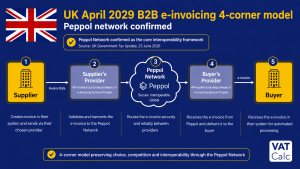
The UK government on 23 June 2026 confirmed that the Peppol network will serve as the interoperability framework for mandatory B2B e-invoicing from April 2029. It will be a 4-corner Peppol model without e-reporting obligations (yet!). A detailed roadmap is expected at the November 2026 Budget.
There still may be a phased introduction – starting with larger businesses in April 2029.

UK e-invoicing mandate 1st April 2029 – likely phasing
The timetable for any launch would likely be as follows (my estimate!):
- 26 Nov 2025: confirmation of e-invoicing without e-reporting at UK Autumn Budget;
- Nov 2026 Budget to provide details of regime design, scope and phased introduction from April 2029
- 2026-29: Development of legislation, technical spec’s, accreditation framework & consultations
- 2028: Software provider development, taxpayer testing, pilots & onboarding.
- April 2029 1st phase mandate launch
- April 2030: potential second phase for small taxpayers
Early 2025 consultation completed
HMRC’s consultation on e-invoicing closed in May 2025. The exercise sought views on how to increase adoption of e-invoicing across UK businesses and the public sector, whilst assessing the design of a future mandatory regime.
The consultation considered:
- Centralised versus decentralised exchange models;
- Voluntary versus mandatory adoption;
- Preparation periods required before implementation;
- Existing levels of awareness and adoption;
- Potential interaction with digital tax reporting obligations;
- Opportunities for pre-populated VAT returns and wider tax digitalisation.
With Peppol now confirmed as the interoperability framework, the remaining design questions largely concern implementation scope, technical standards, accreditation requirements and any future digital reporting obligations.
UK adopts a decentralised Peppol model
The UK’s decision confirms a decentralised four-corner exchange model based on the Peppol network.
Under this approach, suppliers and buyers exchange structured invoices through their chosen software providers or Peppol access points. HMRC does not receive invoice data in real time as part of the initial mandate.
The model closely resembles Belgium’s first phase e-invoicing regime introduced from 2026. A later phase could potentially introduce digital reporting requirements, creating a five-corner model involving HMRC.
The confirmation of Peppol provides businesses with significantly greater certainty than was available during the original consultation period.
UK taxpayers may already voluntarily use electronic invoices on B2B transactions if they have mutual agreement between parties. An e-invoice contains the same information as a paper invoice, but is in a structured, machine readable electronic format. HMRC’s Making Tax Digital for VAT introduced VAT return digital filing in 2019, followed by 2021 digital journey requirements for preparing VAT returns.
EU member states already raising billions with digital reporting
The EU is considering a single standard via its VAT in the Digital Age reforms. Countries such as Italy have already demonstrated major tax revenue boosts from their e-invoicing implementations. Countries such as France, Germany, Poland and Belgium have their own domestic versions launching shortly.
The introduction of e-invoicing can significantly reduce administrative tasks, improve cash flow, boost productivity, introduce automation, and reduce errors in tax returns – all helping to close the tax gap. The consultation will gather input from businesses on how HMRC can support investment in and encourage e-invoicing uptake.
UK e-invoicing rules still follow EU VAT
The UK’s e-invoice rules are primarily shaped by VAT regulations and efforts to align with digital business practices. E-invoicing is allowed but not mandatory in the UK, and its usage is oversee by HMRC. Businesses must ensure that e-invoices meet the same legal requirements as paper invoices, including essential details such as supplier and customer information, VAT number, description of goods or services, total VAT due, and invoice date.
To be valid, an e-invoice must be authentic, intact, and legible. Authenticity refers to verifying the origin of the invoice, integrity ensures no alterations, and legibility means that the invoice can be easily read, both when sent and stored.
Storage requirements also apply, and invoices must be kept for six years in a format that guarantees access, readability, and retrieval. The UK has embraced the EU’s VAT Invoicing Directive, which allows electronic and paper invoices to be treated equally for tax purposes. Although the UK left the EU, these guidelines continue to apply, supporting businesses’ transition to digital systems. Moreover, MTD initiative encourages businesses to adopt digital tools, including e-invoicing, for VAT compliance.