

Mandatory eÁFA system a shift towards tax authority data validation – delayed till 1 January 2028 for most businesses
Placing greater importance on accurate VAT determination and ERP reconciliation

From 1 January 2028, eÁFA becomes mandatory, with the existing ÁNYK VAT return process discontinued for most businesses. Large businesses will start the transition sometime in 2027 – TBC.
Tax authorities possessing transaction-level data ≠ reliable pre-filled VAT returns
But this follows a 12 month proposed delay announced on 15 October 2026 whereby large businesses will proceed in 2027, but the majority from 1 January 2028.
NAV already receives enormous amounts of transaction-level information; Hungary is already one of Europe’s most data-rich VAT administrations. The delay to 2028 for most businesses reveals the bottle neck is not obtaining tax data; but getting taxpayer systems capable of consuming, validating and reconciling it reliably.
January 2028: two alternatives to file
Businesses will file through either:
- NAV’s web interface; or
- the machine-to-machine M2M channel.
The choice depends on invoice volumes, transaction complexity and how much manual reconciliation is required.
However, the significance of eÁFA extends beyond replacing traditional VAT returns. Hungary is demonstrating what happens when the tax authority already holds much of the taxpayer’s transaction data before the VAT return is submitted.
How eÁFA works
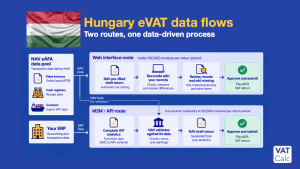
Hungary’s NAV draws together data from:
- Online Számla (RTIR) sales invoice reporting
- online cash registers
- customs and import VAT records
However, NAV does not hold everything. Intra-Community acquisitions, services received from foreign suppliers and other transactions outside these reporting systems must come from the taxpayer’s own records.
How this information is used depends on the filing route.
1 Web interface: NAV prepares the starting point
For taxpayers below the 100,000-invoice threshold, NAV uses its transaction data to produce a pre-filled draft VAT return with automatic tax coding.
The taxpayer reconciles this against its own accounting records, corrects or recodes items and adds missing transactions, including intra-Community acquisitions and imported services.
The completed draft is then approved and submitted through eÁFA.
2 M2M: the taxpayer provides the starting point
The M2M/API route works differently.
The taxpayer prepares complete VAT analytics from its own ledger, including both transactions NAV already holds and those it does not, and submits the data in NAV’s XML format.
NAV validates the analytics against its own transaction data, returning errors and warnings where differences are identified. Once validated, NAV generates the draft VAT return for approval.
M2M can be used at any volume and is required at 100,000 invoices or more. NAV introduced the eÁFA M2M 2.0 schema in August 2026.
Two routes to a data-driven VAT return
The distinction is important. Under the web route, NAV’s data is the starting point and the taxpayer reconciles it against its records. Under M2M, the taxpayer’s complete VAT data is the starting point and NAV validates it against its records.
Both ultimately produce an eÁFA draft return for taxpayer approval.
This shifts Hungarian VAT compliance away from simply preparing and submitting return totals towards reconciling transaction-level tax authority and ERP data before filing.
VAT compliance moves upstream into the transaction
The important change is that the VAT return is increasingly becoming the output of a compliance process rather than its starting point.
Traditionally, businesses could identify and correct VAT errors while preparing their periodic returns.
Under eÁFA, the tax authority may already possess the underlying invoice information. Differences between its records and the taxpayer’s VAT position become more visible.
Consequently, businesses must increasingly ensure that transactions are treated correctly when they are first recorded.
This places greater importance on:
- VAT determination: Applying the correct VAT treatment when transactions are created.
- Tax codes and master data: Ensuring ERP classifications reflect the underlying VAT legislation.
- Transaction accuracy: Correct invoice dates, values, VAT numbers and reporting periods.
- Data completeness: Identifying transactions missing from either the ERP or tax authority records.
The responsibility for VAT accuracy therefore extends beyond the tax department into accounts payable, accounts receivable and ERP processes.
From VAT return preparation to transaction-level reconciliation
Perhaps the most significant consequence of eÁFA is the growing importance of VAT reconciliation.
Traditional VAT reconciliation typically compares accounting balances against the amounts reported in VAT returns.
However, this may establish that a discrepancy exists without explaining its underlying cause.
Transaction-level reconciliation goes further, comparing the taxpayer’s individual transactions with the information held by NAV.
Differences may arise from incorrect VAT determination, missing invoices, inconsistent tax codes, reporting dates or transactions recorded differently by the taxpayer and tax authority.
Identifying these discrepancies before filing allows businesses to investigate and correct errors at their source.
For larger businesses, automated reconciliation between ERP records, e-invoice reporting and VAT return data will become increasingly important.
Hungary offers a preview of VAT compliance under ViDA
Hungary’s approach also illustrates the direction of European VAT compliance.
The EU’s VAT in the Digital Age (ViDA) reforms will introduce mandatory digital reporting for intra-Community B2B transactions from July 2030.
Alongside expanding national e-invoicing mandates, these developments will give tax authorities increasingly detailed information about taxpayers’ transactions.
As more countries introduce pre-filled VAT returns, businesses will face a growing requirement to reconcile their own records against information already available to tax authorities.
The challenge is shifting from preparing an accurate VAT return to demonstrating that the underlying transactions were treated correctly in the first place.
This makes accurate VAT determination, integrated reporting and automated reconciliation increasingly interconnected requirements.
Hungary’s eÁFA system offers an early illustration of that future.
Jan 2024 NAV confirms eVAT (eÁFA) pre-filled VAT returns live
Builds on RTIP real-time invoicing; initially voluntary pre-completed VAT returns and tax-code mapping service
Hungary’s National Tax and Customs Administration (‘NAV’) confirmed on 1 January 2024 its new platform, eVAT, to enable taxpayers to freely access pre-filled VAT returns. The first returns may approved and submitted from February (monthly) or April (quarterly). Taxpayers may already review and interrogate data on the portal which has been gathered from: Hungarian live invoice reporting RTIP, fiscal cash registers and customs documentation. From 1 February, all functions will be available, such as changing the tax code, closing the period, preparing a draft return, pre-auditing and submitting the return.
eVAT goes beyond the OECD SAF-T model adopted in several European countries for the standardised exchange of data between the tax authorities and taxpayers. Similar to digital ledger regimes in South America and Greece’s myDATA regime, it means NAV already has a live, complete record of taxpayers’ VAT transactions. It will initially be a VAT transaction-only schema; but long term will be extended to other declaration types.
NAV also offers taxpayers a set of analytics tool to review and interrogate their VAT data set to help identify trends or errors for further investigation. Long term, as NAV can cross-check taxpayers’ transactions in eVAT, this will be particularly beneficial for taxpayers to understand misreporting of their transactions elsewhere in the supply chain.
In addition to resident Hungarian businesses, eVAT will be open to non-resident businesses with a foreign Hungarian VAT number, providing taxable supplies in Hungary.
Building on success of RTIP live invoice reporting
eVAT is based on the transactional data which taxpayers have been required to submit in real-time on the RTIP regime since July 2018. The requires near live submissions of B2B and B2C sales invoices. It also incorporates data from Hungary’s live cash-register reporting regime.
eVAT will replace the monthly obligation for a Control Statement, ‘M-forms’. This lists all domestic transactions for goods and services for VAT deductions.
NAV is proposing two routes to utilise eVAT, addressing the separate needs and preferences of small and large taxpayers. In both cases, aside from summary-level pre-filled VAT returns, taxpayers will be able to dynamically drill down into transactions to examine and issues. The current manual ÁNYK return filing option will remain in place, too.
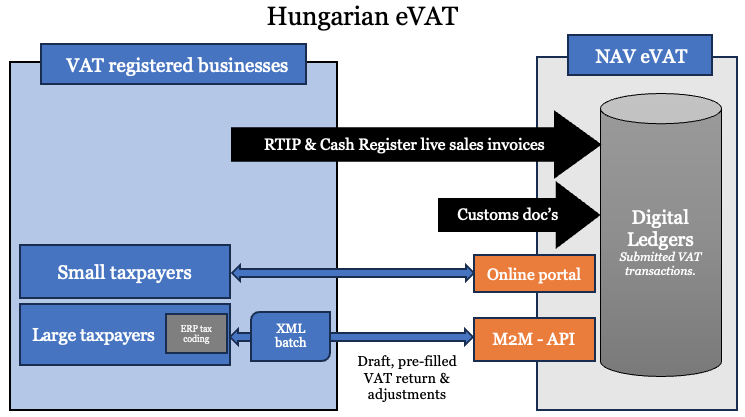
1. Small taxpayers – free online access
Taxpayers, or their advisors, will be able to login to a online portal to access their VAT transactional data. From there, they can run basic analytics, supplement any missing transactional information, including adding new invoice transactions, in their NAV ledgers and make amendments where appropriate. They are then able to review and approve a draft VAT return.
2. Large taxpayers – M2M tax code-based assistance
Whilst pre-filled VAT returns present a free and convenient route for small taxpayers, most medium and enterprise taxpayers have more complex business models such as intra-group trading and international transactions. But dealing with these transactions on a frontend can be cumbersome and counter-productive.
To help them, NAV has developed a unique standard tax code map. Large enterprises can map their own ledgers / tax codes to this, can opt to submit full XML transaction details via a newly created API. This will be known as ‘Machine-to-Machine’ or ‘M2M’.
Once received, there is a basic data validation of two types:
- File structure and format
- Cross-checking data with other sources and analytics.
Transactions are stored in a data pool, similar to digital ledgers along with collected RTIR, cash register and customs information. After this acceptance procedure the user can move to the preparation of a draft VAT return.
In addition to then being able to access more accurate returns, this process will also automate reconciliations with NAV’s RTIP records. This will enable both sides to readily identify discrepancies, and resolve them, rather than trigger disruptive and costly audit investigations.
Since the data is being exchanged via API, this will open for the first time the opportunity for large taxpayers to interrogate NAV’s transaction records on their activities, and facilitate more readily any differences to be investigated.
Free data analytics tools
To help taxpayers fully understand and cross-check their VAT return data set, NAV is offering a suite of analytical tools.
The online portal will offer plenty pre-defined views for aggregated and itemized browsing (drill-down, slicing-dicing). This covers all three data sources that constitute a VAT declaration: invoices, cash receipts and customs declarations) These views can also be customized and saved as a personal template to use for future work. The UI also includes summary views and a pre-defined VAT analytics view to look at the flagged numbers before making a declaration submission.
The M2M API will both aggregated and itemized query operations for the clients, so they can build any analytics they want from the provided data. This can be done with tools such as PowerBI.
If a taxpayer has completed their data submission, per the analytic tools reporting, NAV is not likely to request further tax information from the tax payer in the case of an audit.
Read more in our Hungary VAT country guide.
Many thanks to Csaba Kocsis, from i-Cell Mobilsoft, in compiling this blog.


