New supporting regulations confirms Peppol as preferred exchange for 2028 B2B proposed mandate
27 Aug 2026: draft regulations confirms Peppol network as the designated network for issuing, transmitting and receiving structured e-invoices. But it also provides MyGuichet.lu as fallback.
17 July: Luxembourg’s Council of Ministers publishes draft legislation introducing B2B electronic invoicing for domestic transactions, with a phased rollout beginning in 2028.

Subject to parliamentary approval, the proposed timetable according to the Chamber of Commerce is:
- 1 January 2028 – All businesses must be able to receive electronic invoices.
- 1 July 2028 – Large and medium-sized businesses must issue electronic invoices.
- 1 January 2029 – The obligation to issue electronic invoices extends to all remaining businesses.
This ties to the July 2030 EU ViDA Digital Reporting Requirements imposing the exchange of structured e-invoices on intra-community supplies.
4-corner Peppol network adopted
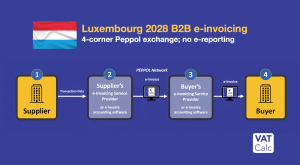
The government has also approved a draft Grand-Ducal Regulation establishing a common network and alternative transmission methods. The objective is to ensure businesses use interoperable technical solutions rather than separate proprietary networks. The model will be a 4-corner Peppol model, with future potential for 5-corner e-reporting requirements.
The new mandate will build on Luxembourg’s existing Peppol infrastructure used for B2G e-invoicing. During 2024, almost 1.4 million invoices were exchanged via Peppol in Luxembourg, involving around 800 public bodies and more than 1,400 private entities.
Domestic e-invoicing scope
The following transactions are in-scope:
- the supplier is established in Luxembourg;
- the customer is also established in Luxembourg; and
- the supply is taxable in Luxembourg.
Structured electronic invoices
The legislation requires structured electronic invoices based on EN16931 EU standard rather than PDF invoices sent by email. Invoice data must be exchanged in a machine-readable format that accounting and ERP systems can automatically process.
MyGuichet alternative to Peppol
The draft Regulation also provides MyGuichet.lu alternatives, principally as transitional or fallback solutions. For receiving e-invoices, businesses may temporarily use a certified MyGuichet.lu business space instead of Peppol. Based on 2026 financial data:
- businesses exceeding at least two of the €7.5 million balance sheet, €15 million turnover and 50 employee thresholds may use this option until 30 June 2028;
- businesses below these thresholds may use it until 31 December 2028.
Receipt through MyGuichet will be free for the first 150 e-invoices, after which progressive per-invoice charges will apply.
For issuing e-invoices, MyGuichet will offer two alternatives without a stated expiry date: businesses may either manually create a compliant e-invoice using an online form or upload and transmit an e-invoice already prepared in the required structured format. These services will be free for up to 75 issued invoices before charges apply.
The government describes these alternatives as backup solutions rather than substitutes for Peppol, which is expected to become the standard route for automated B2B invoice exchange.
Bill subject to parliamentary approval
The bill must still complete Luxembourg’s parliamentary process before becoming law, but the proposed implementation timetable provides businesses with almost two years to prepare.
Luxembourg SAF-T also operates an on-demand.